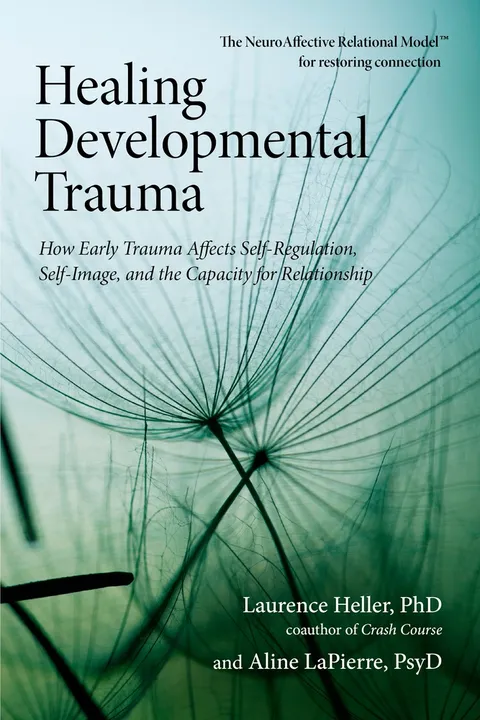
Healing Developmental Trauma
How Early Trauma Affects Self-Regulation, Self-Image, and the Capacity for Relationship
Report an issue
Tell us what's wrong and we'll take a look.
Thanks – we got it. We'll review and follow up if needed.
Although it may seem that people suffer from an endless number of emotional problems and challenges, Laurence Heller and Aline LaPierre maintain that most of these can be traced to five biologically based organizing principles: the need for connection, attunement, trust, autonomy, and love-sexuality. They describe how early trauma impairs the capacity for connection to self and others and how the ensuing diminished aliveness is the hidden dimension that underlies most psychological and many physiological problems.
Heller and LaPierre introduce the NeuroAffective Relational Model(R) (NARM), a method that integrates bottom-up and top-down approaches to regulate the nervous system and resolve distortions of identity such as low self-esteem, shame, and chronic self-judgment that are the outcome of developmental and relational trauma. While not ignoring a person's past, NARM emphasizes working in the present moment to focus on clients' strengths, resources, and resiliency in order to integrate the experience of connection that sustains our physiology, psychology, and capacity for relationship.
Aline Lapierre
Aline LaPierre, PsyD, is an adjunct faculty member in the somatic doctoral program at Santa Barbara Graduate Institute. Trained as a psychoanalyst and as a hands-on somatic psychotherapist, she has been in private practice in Los Angeles for more than 25 years.


Why Readwise Books?
Readwise Books is an ebook & audiobook platform that automatically logs how much you and your friends read, making it fun and easy to read more. Learn more →