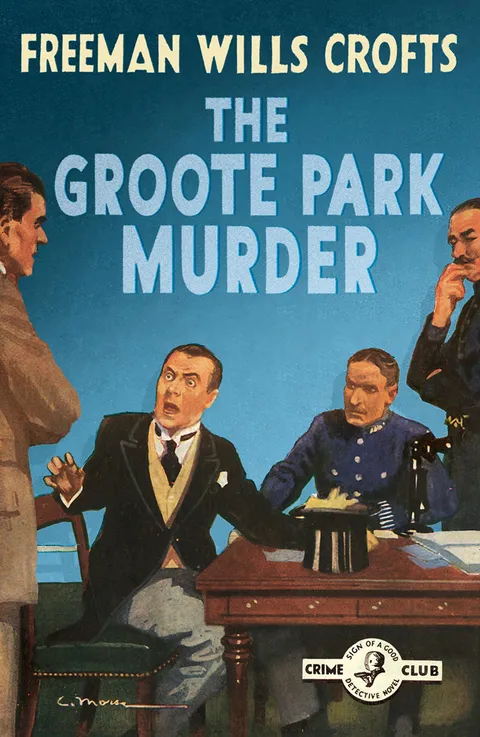
The Groote Park Murder
Report an issue
Tell us what's wrong and we'll take a look.
Thanks – we got it. We'll review and follow up if needed.
From a murder in South Africa to the tracking down of a master criminal in northern Scotland, this is a true classic of Golden Age detective fiction by one of its most accomplished champions.
When a signalman discovers a mutilated body inside a railway tunnel near Groote Park, it seems to be a straightforward case of a man struck by a passing train. But Inspector Vandam of the Middeldorp police isn’t satisfied that Albert Smith’s death was accidental, and he sets out to prove foul play in a baffling mystery which crosses continents from deepest South Africa to the wilds of northern Scotland, where an almost identical crime appears to have been perpetrated.
The Groote Park Murder was the last of Freeman Wills Crofts’ standalone crime novels, foreshadowing his iconic Inspector French series and helping to cement his reputation (according to his publishers) as ‘the greatest and most popular detective writer in the world’. Like The Cask, The Ponson Case and The Pit-Prop Syndicate before it, here were a delightfully ingenious plot, impeccable handling of detail, and an overwhelming surprise ‘curtain’ from a masterful crime writer on the cusp of global success.
This Detective Club classic is introduced with an essay by Freeman Wills Crofts, unseen since 1937, about ‘The Writing of a Detective Novel’.
Freeman Wills Crofts
Freeman Wills Crofts (1879–1957) was an Irish author of detective fiction. Born in Dublin, he spent decades as a railroad engineer in Northern Ireland. When a long illness kept him away from work, he wrote The Cask (1920), a mystery novel that launched him to immediate popularity. He continued writing after he returned to work, finally leaving the railroad in 1929 to write full time. His best-known novels include The Starvel Hollow Tragedy (1927) and The 12:30 from Croydon (1934).
More by Freeman Wills Crofts


Why Readwise Books?
Readwise Books is an ebook & audiobook platform that automatically logs how much you and your friends read, making it fun and easy to read more. Learn more →