
Over the Moon
Report an issue
Tell us what's wrong and we'll take a look.
Thanks – we got it. We'll review and follow up if needed.
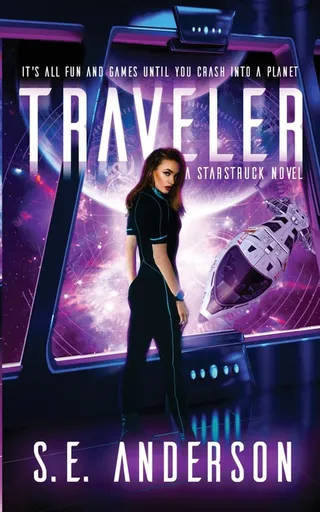
Ding Dong, the Technowitch is dead.
As an illegal clone of the murdered galactic princess, Dora's face would get her killed the minute she steps off her dull farming moon. She spends her days tinkering with gadgets and gears, with Tau, her kitchen-timer-bot, for company. But when forces close in and threaten her family, her escape attempt lands her deep in the Outer Zone - and on top of the Technowitch of Night, crushing her in the process.
Now a fugitive in two solar systems, Dora's only chance of survival is to find her way to the mysterious Technomage on his Emerald moon. In a place where science has advanced to be indistinguishable from magic, she must accept the help of an unlikely trio: a cryogenically-preserved girl with no memory, an obsolete theme park droid, and a bioengineered beast with a penchant for the dramatic.
As Dora realizes there's more to the princess's death than what the universe has been told, she must choose - save her family, or risk everything to right a centuries-old wrong.
S E Anderson
S.E. Anderson, a veteran actiovist/educator, has been in the Black Liberation Movement on many levels. He is not only a mathematics professor, a Senior Editor (NOBO: Journal of African Dialogue), a founding member of the Network of Black Organizers and of The African Heritage Studies Association but also an essayist on a variety of topics related to black culture and liberation as well as science and technology. His political and cultural activism in his native New York City ranges from helping to fund the New York City Algebra Project to being a founding member of the New York City Coalition For Excellence In Black Education.
As a young activist, Anderson was a member of the Student Nonviolent Coordinating Committee (SNCC) and helped found the Black Panther Party in Harlem in 1966. He has been active in the African Liberation Support Movement since 1964 and participated in the historic Black student/community struggle against Columbia University's encroachment into Harlem in 1968. Ironically, almost twenty years later, he became a Columbia University Revson Fellow (1986-7). In addition, he has taught mathematics, science, and Black Studies at Queens College...
Anderson became one of the first Black Studies Chairs, when in 1969 he accepted the challenge at Sarah Lawrence College to create a department that included mathematics and the natural sciences as part of a Black Studies Curriculum.
More by S E Anderson








Why Readwise Books?
Readwise Books is an ebook & audiobook platform that automatically logs how much you and your friends read, making it fun and easy to read more. Learn more →