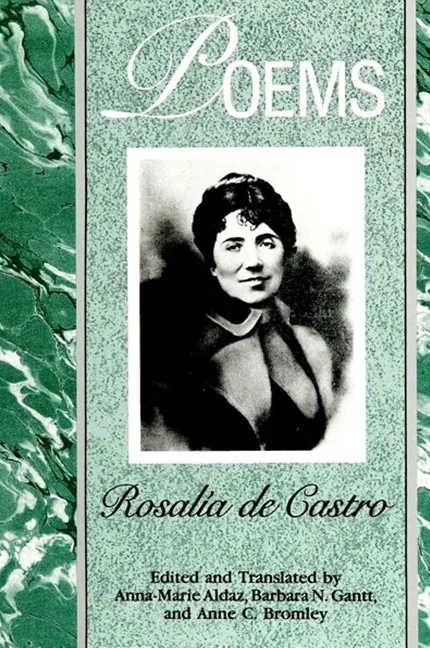
Poems
Report an issue
Tell us what's wrong and we'll take a look.
Thanks – we got it. We'll review and follow up if needed.
This book presents translations of poems by the Spanish poet, Rosalía de Castro, who is today considered one of the outstanding figures of nineteeth-century Spanish literature. Her poetry, often compared to that of Emily Dickinson, is characterized by an intimate lyricism, simple diction, and innovative prosody.
Included here are a critical introduction, notes to the translations, two of the poet's own autobiographical prologues that have never before been translated, and over one hundred poems translated from both Gallician and Spanish. The selected poems are from de Castro's most important books, Cantares gallgos; Follas novas; and En las orillas del Sar.
Rosalia De Castro
Rosalía de Castro, née María Rosalía Rita, was born in 1837, the illegitimate daughter of a priest and a woman from an established bourgeois family, near Santiago de Compostela in Galicia. So far as is known, her father had no contact with Rosalía after her birth. Her illegitimacy waqs to play a considerable role in the development of Rosalía's character. In the Spain of her time, not only was it a great disgrace to be illegitimate, but worse still was to be known as a 'sacrilegious' child, i.e. the offspring of a cleric.Her first small collection of poems, La flor (The Flower), was published in Madrid in 1857 and received a warm review from Miguel Murguía, a journalist whom she had already met in Santiago. Her relationship with Murguía resulted in their marriage in 1858. For the next few years Rosalía and her husband lived in various places, including Santiago, Madrid, Lestrove, A Coruña. The marriage produced six children, one of whom was stillborn while another died after a year. A second book in Spanish was published in Vigo in 1863, A mi madre (To My Mother). Rosalía's first poem in Galician was published in 1861, and in 1863, her collection Cantares gallegos (Galician Songs) appeared, representing a major contribution to the revival of Galician literature after centuries of non-existence, indeed since the Middle Ages. Cantares gallegos went into a second, expanded edition in 1872, and was followed by another Galician volume Follas novos (New Leaves) in 1880 and, finally, a last Spanish volume, En las orillas del Sar (On the Banks of the Sar) in 1884. Rosalía died in 1885, and her manuscripts were destroyed by her eldest daughter, on the author's instructions.Her work was consistently under-rated in her lifetime, at least in Castilian circles, and it is fair to say that she suffered because she was a woman poet, first and foremost, but also because she was 'provincial' and because she wrote much of her work in Galician. In the 20th century her work was reappraised, by García Lorca and Cernuda, among others, and she is now recognised as a major writer in both languages.


Why Readwise Books?
Readwise Books is an ebook & audiobook platform that automatically logs how much you and your friends read, making it fun and easy to read more. Learn more →