
Until We're Seen
Public College Students Expose the Hidden Inequalities of the COVID-19 Pandemic
Report an issue
Tell us what's wrong and we'll take a look.
Thanks – we got it. We'll review and follow up if needed.

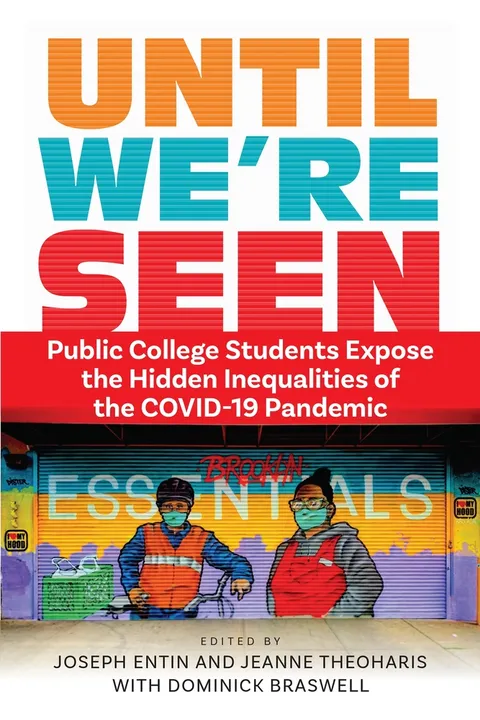
Firsthand accounts of COVID-19’s devastating effects on working-class communities of color
The first months of the COVID-19 pandemic were filled with talk of heroes, the frontline workers who kept the country functioning. “And when they write those history books, the heroes of the battle will be the hardworking families of New York,” Governor Andrew Cuomo trumpeted on Labor Day 2020. But what if those heroes, those essential workers and their families, wrote the book themselves?
In Until We’re Seen, the heroes write their own stories. Through firsthand accounts by college students at Brooklyn College and California State University Los Angeles, Until We’re Seen chronicles COVID-19’s devastating, disproportionate effects on working-class communities of color, even as the United States has declared the pandemic over and looks away from its impacts.
Very few of these students and their families had the luxury of laboring from home; if they were able to keep their jobs, they took subways and buses, and they worked. They drove delivery trucks, worked in private homes, cooked food in restaurants for people to pick up, worked as EMTs, and did construction. They couldn’t escape to second homes; if anything, more people moved in, as families were forced to consolidate to save money. Together, the accounts in this book show that the COVID-19 pandemic did discriminate, following the race and class fissures endemic to US society. But if these are tales of hardship, they are also love stories—of students’ families, biological and chosen—and of the deep resolve, mundane carework, and herculean efforts such love entails.
Recounting 2020–2022 through the experiences of predominantly young, working-class immigrants and people of color living in the first two major US COVID-19 epicenters, Until We’re Seen spotlights previously untold stories of the pandemic in New York, Los Angeles, and the nation as a whole.
Joseph B Entin
Joseph B. Entin is associate professor of English at Brooklyn College, City University of New York.
Jeanne Theoharis
Jeanne Theoharis is Distinguished Professor of Political Science at Brooklyn College of City University of New York. She is the author of the New York Times bestselling The Rebellious Life of Mrs. Rosa Parks and winner of the 2014 NAACP Image Award for Outstanding Literary Work Biography/Autobiography and the Letitia Woods Brown Award from the Association of Black Women Historians. Her book has been adapted into a documentary of the same name, executive produced by Soledad O'Brien for Peacock where Theoharis served as a consulting producer. Her young adult adaptation with Brandy Colbert, The Rebellious Life of Mrs. Rosa Parks for Young People, was included in the Best Books of 2021 by the Chicago Public Library and Kirkus Reviews. Her book A More Beautiful and Terrible History: The Uses and Misuses of Civil Rights History won the 2018 Brooklyn Public Library Literary Prize in Nonfiction and was named one of the best Black history books of 2018 by Black Perspectives. Theoharis's writing has appeared in The New York Times, The Washington Post, MSNBC, The Nation, Slate, The Atlantic, and many more. She lives in Brooklyn.


Why Readwise Books?
Readwise Books is an ebook & audiobook platform that automatically logs how much you and your friends read, making it fun and easy to read more. Learn more →