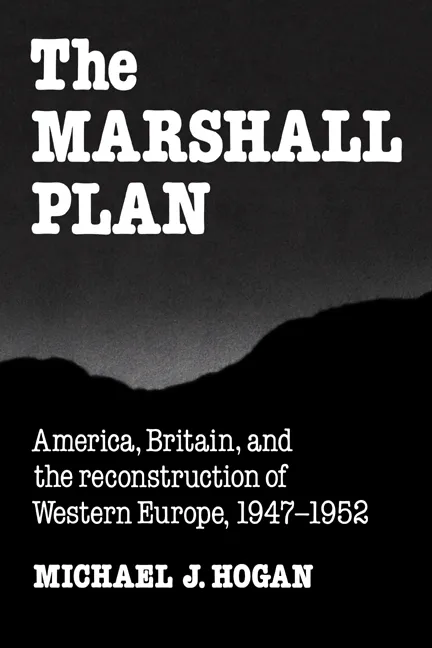
The Marshall Plan
America, Britain and the Reconstruction of Western Europe, 1947 1952
Report an issue
Tell us what's wrong and we'll take a look.
Thanks – we got it. We'll review and follow up if needed.
Michael Hogan shows how The Marshall Plan was more than an effort to put American aid behind the economic reconstruction of Europe. American officials hoped to refashion Western Europe into a smaller version of the integrated single-market and mixed capitalist economy that existed in the United States. Professor Hogan's emphasis on integration is part of a major reinterpretation that sees the Marshall Plan as an extension of American domestic and foreign-policy developments stretching back through the interwar period to the Progressive Era. Michael Hogan is Professor of History at Ohio State University and editor of Diplomatic History.
Michael J Hogan
Michael J. Hogan is Distinguished Professor of History at the University of Illinois, Springfield. Hogan is the author of A Cross of Iron: Harry S. Truman and the Origins of the National Security State, 1945-1954 (2000); Informal Entente: The Private Structure of Cooperation in Anglo-American Economic Diplomacy, 1918-1928 (1977); and The Marshall Plan: America, Britain, and the Reconstruction of Western Europe, 1947-1952 (1987). He is co-editor of Explaining American Foreign Relations History, 2nd edition (with Thomas G. Paterson, Cambridge, 2003). Professor Hogan is a former president of the Society for Historians of American Foreign Relations, and served for fifteen years as editor of its journal, Diplomatic History.
More by Michael J Hogan


Why Readwise Books?
Readwise Books is an ebook & audiobook platform that automatically logs how much you and your friends read, making it fun and easy to read more. Learn more →