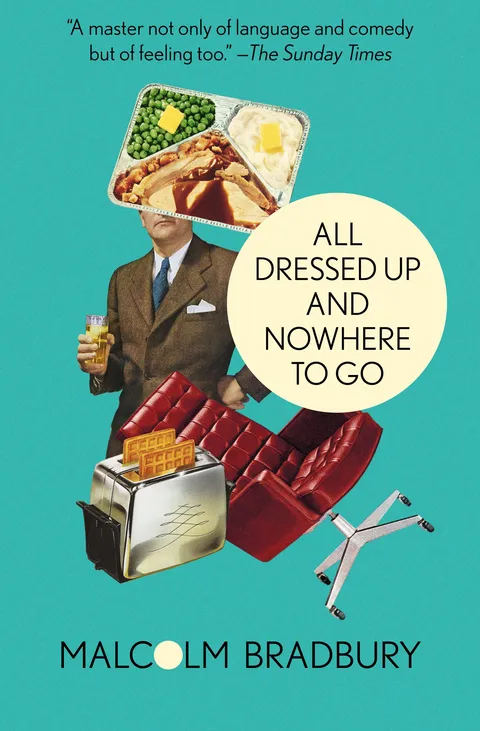
All Dressed Up and Nowhere to Go
Report an issue
Tell us what's wrong and we'll take a look.
Thanks – we got it. We'll review and follow up if needed.
Malcolm Bradbury's humorous look at Britain's transition to midcentury modernity After spending a year teaching in an American university in the 1950s, Malcolm Bradbury returned to England only to realize that his native country had become nearly as mystifying to him as the American Midwest. As Britain marched toward a new decade, much of the country was changing inexorably, its agrarian past paved over by suburban developers, its quiet traditionalism replaced by beehive hairdos and shiny, glass-walled office buildings. And so, to confront this curious moment in British history, Bradbury turned to the sharpest tool in his arsenal: humor. In All Dressed Up and Nowhere to Go, he writes of a country balancing precariously on the boundary of two worlds, with the wry wit and keenly observant eye that have made him one of the twentieth century's greatest satirists.
Malcolm Bradbury
Malcolm Bradbury was a well-known novelist, critic and academic. He co-founded the famous creative writing department at the University of East Anglia, whose students have included Ian McEwan and Kazuo Ishiguro. His novels are Eating People is Wrong; Stepping Westward; The History Man, which won the Royal Society of Literature Heinemann Prize; Rates of Exchange, shortlisted for the Booker Prize; Cuts; Doctor Criminale; and To the Hermitage. He wrote several works of non-fiction, humour and satire, including Who Do You Think You Are?, All Dressed Up and Nowhere to Go and Why Come to Slaka?. He was an active journalist and a leading television writer, responsible for the adaptations of Porterhouse Blue, Cold Comfort Farm and many TV plays and episodes of Inspector Morse, A Touch of Frost, Kavanagh QC and Dalziel and Pascoe. He was awarded a knighthood in 2000 for services to literature and died later the same year.
More by Malcolm Bradbury


Why Readwise Books?
Readwise Books is an ebook & audiobook platform that automatically logs how much you and your friends read, making it fun and easy to read more. Learn more →