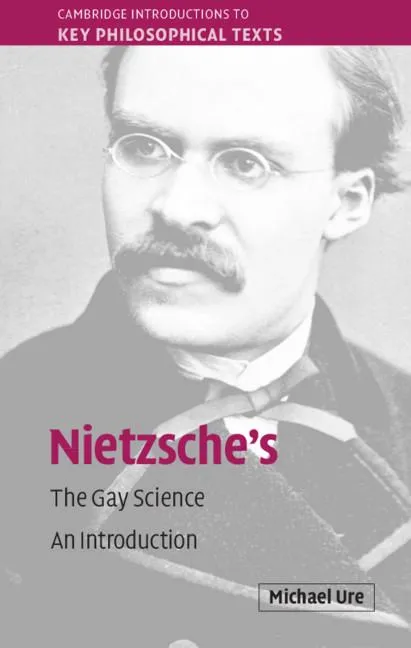
Nietzsche's The Gay Science
Report an issue
Tell us what's wrong and we'll take a look.
Thanks – we got it. We'll review and follow up if needed.
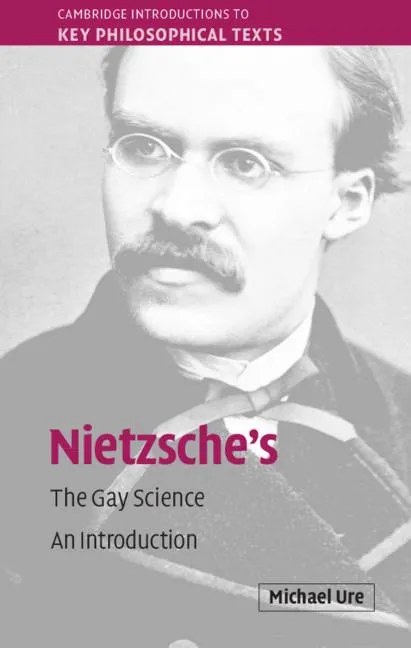
Nietzsche's The Gay Science (1882/1887) is a deeply personal book, yet also an important work of philosophy. Nietzsche conceives it as a philosophical autobiography, a record of his own self-transformation. In beautifully composed aphorisms he communicates his central experience of overcoming pessimism and recovering the capacity to affirm joyfully the tragedy of life. On the basis of his experiments in living, Nietzsche articulates his most famous philosophical concepts and images: the death of God, the exercise of eternal recurrence, and the ideal of self-fashioning. This book explains the ancient and modern philosophical contexts that shape Nietzsche's central concern with the affirmation of life. It surveys Nietzsche's philosophy as a whole, explains the pivotal place of The Gay Science as the source of his ideal of tragic joy, and shows how he revives an ancient conception of philosophy as a way of life and the philosopher as physician.
Michael Ure
Michael Ure is Senior Lecturer in Politics in the School of Political and Social Inquiry, Monash University, Australia. He is author of Nietzsche's Therapy: Self-Cultivation in the Middle Works (2008) and Nietzsche's 'The Gay Science' (2018) and co-editor of The Politics of Compassion (2014)
More by Michael Ure


Why Readwise Books?
Readwise Books is an ebook & audiobook platform that automatically logs how much you and your friends read, making it fun and easy to read more. Learn more →