Report an issue
Tell us what's wrong and we'll take a look.
Thanks – we got it. We'll review and follow up if needed.
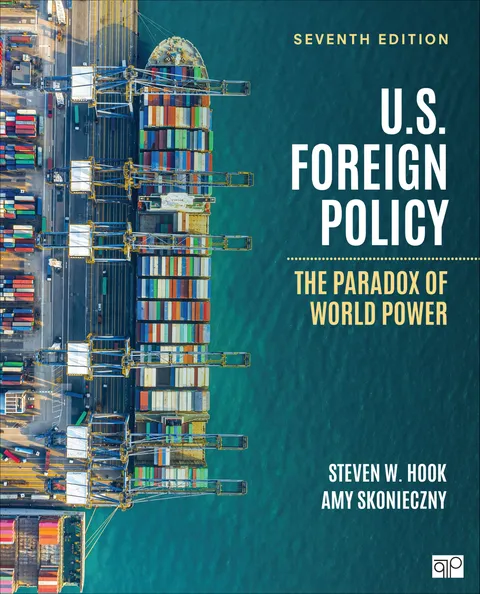
The same aspects of American government and society that propelled the United States to global primacy have also hampered its orderly and successful conduct of foreign policy. This paradox challenges U.S. leaders to overcome threats to America′s world power in the face of fast-moving global developments and political upheavals at home. U.S. Foreign Policy explores this paradox, identifies its key sources and manifestations, and considers its future implications. Authors Steven W. Hook and Amy Skonieczny help students learn how to think critically about these cascading developments and the link between the process and the conduct of U.S. foreign policy.
Steven W. Hook
Steven W. Hook (1959-2022) was professor of political science at Kent State University. In addition to this book, he was co-author of American Foreign Policy Since World War II (CQ Press, 2019, 21st ed., with John Spanier) and author of National Interest and Foreign Aid (Lynne Rienner, 1995). His edited books include U.S. Foreign Policy Today: American Renewal? (CQ Press, 2012, with James M. Scott), the Routledge Handbook of American Foreign Policy (Routledge Press, 2012, with Christopher M. Jones), and Democratic Peace in Theory and Practice (Kent State University Press, 2010). His journal articles have appeared in World Politics, International Studies Quarterly, Asian Survey, Foreign Policy Analysis, International Interactions, and other leading journals. Professor Hook received a BA (1982) in Journalism and Political Science from the University of Michigan and an MA (1990) and PhD (1993) in International Studies from the University of South Carolina. At Kent State, he received the university's Distinguished Teaching Award in 2007 and served as department chair from 2008 to 2012. He was a past president of the Foreign Policy Analysis sections of the American Political Science Association and the International Studies Association.
More by Steven W. Hook

Amy Skonieczny
Amy Skonieczny is Professor at San Francisco State University in the International Relations Department. Her research interests include populism and foreign policy, narratives and US trade politics, and the study of national identity and foreign policy discourses. She completed her Ph.D. in Political Science at the University of Minnesota. Skonieczny’s publications over the past five years have focused on the rise of populism in the United States, particularly with the Trump presidency and its impact on US trade policy. She is a co-editor of the book series Global Populisms and a board member of the journal Populism. Her recent publications include “Saying the Unspeakable: Populism, Performance and the Politics of Covid-19,” forthcoming in Populism; Political Communication and Performative Leadership in International Politics, edited by Corina Lacatus, Georg Lofflmann and Gustav Meibauer (with Giorgio Boggio); “The Trump Shock: Populism and Changing Narratives of US Foreign Policy” (with Georg Lofflmann and Rubrick Biegon) in Populist Foreign Policy: Regional Perspectives of Populism in the International Scene, edited by Philip Giurlando and Daniel Wajner (2023); “Economic Security and the US-China Trade War” in Contemporary Cases in U.S. Foreign Policy: From National Security to Human Security, 6th edition, edited by Ralph Carter (2021); "Trump Talk: Rethinking Elections, Rhetoric, and American Foreign Policy" in the journal Politics (2021); and "The Trump Effect: Toxic Politics and Emotional Populism in US-China Relations" (with Ancita Sherel), forthcoming in the special issue "The Effects of Global Populism" in International Affairs (expected Fall 2024).


Why Readwise Books?
Readwise Books is an ebook & audiobook platform that automatically logs how much you and your friends read, making it fun and easy to read more. Learn more →