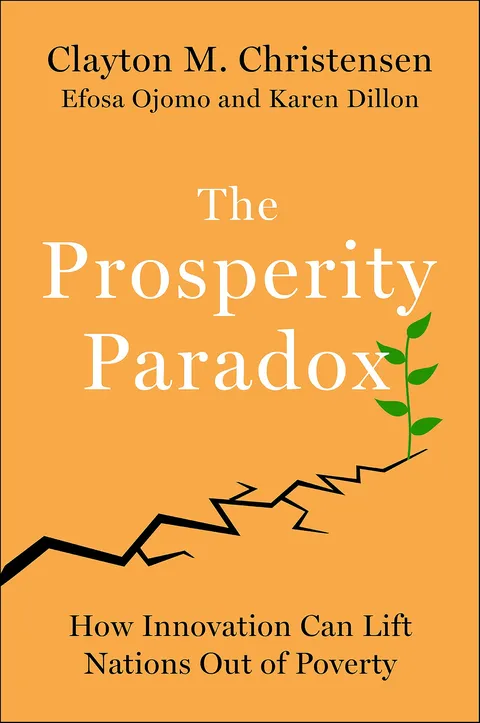
The Prosperity Paradox
How Innovation Can Lift Nations Out of Poverty
Report an issue
Tell us what's wrong and we'll take a look.
Thanks – we got it. We'll review and follow up if needed.
New York Times–bestselling Author: "Powerful . . . a compelling case for the game-changing role of innovation in some of the world's most desperate economies." —Eric Schmidt, former Executive Chairman, Google and Alphabet Clayton M. Christensen, author of such business classics as The Innovator's Dilemma and How Will You Measure Your Life, and co-authors Efosa Ojomo and Karen Dillon reveal why so many investments in economic development fail to generate sustainable prosperity, and offer a groundbreaking solution for true and lasting change. Global poverty is one of the world's most vexing problems. For decades, we've assumed smart, well-intentioned people will eventually be able to change the economic trajectory of poor countries. From education to healthcare, building infrastructure to eradicating corruption, too many solutions rely on trial and error. Essentially, the plan is often to identify areas that need help, flood them with resources, and hope to see change over time. But hope is not an effective strategy. At least twenty countries that have received billions of dollars' worth of aid are poorer now. Applying the rigorous and theory-driven analysis he is known for, Christensen suggests a better way. The right kind of innovation not only builds companies—but also builds countries. The Prosperity Paradox identifies the limits of common economic development models, which tend to be top-down efforts, and offers a new framework for economic growth based on entrepreneurship and market-creating innovation. Christensen, Ojomo, and Dillon use successful examples from America's own economic development, including Ford, Eastman Kodak, and Singer Sewing Machines, and shows how similar models have worked in other regions such as Japan, South Korea, Nigeria, Rwanda, India, Argentina, and Mexico. The ideas in this book will help companies desperate for real, long-term growth see actual, sustainable progress where they've failed before. But The Prosperity Paradox is more than a business book—it is a call to action for anyone who wants a fresh take for making the world a better and more prosperous place.
Clayton M. Christensen
CLAYTON M. CHRISTENSEN (1952–2020) was the Kim B. Clark Professor at Harvard Business School, the author of nine books, a five-time recipient of the McKinsey Award for Harvard Business Review’s best article, and the cofounder of four companies, including the innovation consulting firm Innosight. In 2011 and 2013 he was named the world’s most influential business thinker in a biennial ranking conducted by Thinkers50.
More by Clayton M. Christensen
Efosa Ojomo
Efosa Ojomo works side-by-side with Christensen and the Christensen Institute for Disruptive Innovation, where he leads the organization’s Global Prosperity Practice. His work has been published in the Harvard Business Review, the Guardian, Quartz, CNBCAfrica, and the Emerging Markets Business Review.
More by Efosa Ojomo
Karen Dillon
KAREN DILLON is the former editor of the Harvard Business Review and coauthor of the New York Times bestseller How Will You Measure Your Life? She is a graduate of Cornell University and Northwestern University’s Medill School of Journalism. In 2011 she was named by Ashoka as one of the world’s most influential and inspiring women.
More by Karen Dillon




Why Readwise Books?
Readwise Books is an ebook & audiobook platform that automatically logs how much you and your friends read, making it fun and easy to read more. Learn more →