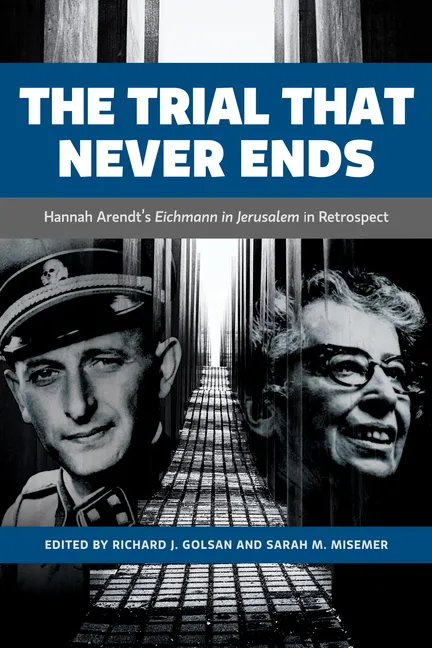
The Trial That Never Ends
Hannah Arendt's 'Eichmann in Jerusalem' in Retrospect
Report an issue
Tell us what's wrong and we'll take a look.
Thanks – we got it. We'll review and follow up if needed.
The fiftieth anniversary of the Adolf Eichmann trial may have come and gone but in many countries around the world there is a renewed focus on the trial, Eichmann himself, and the nature of his crimes. This increased attention also stimulates scrutiny of Hannah Arendt's influential and controversial work, Eichmann in Jerusalem.
The contributors gathered together by Richard J. Golsan and Sarah M. Misemer in The Trial That Never Ends assess the contested legacy of Hannah Arendt's famous book and the issues she raised: the "banality of evil", the possibility of justice in the aftermath of monstrous crimes, the right of Israel to kidnap and judge Eichmann, and the agency and role of victims. The contributors also interrogate Arendt's own ambivalent attitudes towards race and critically interpret the nature of the crimes Eichmann committed in light of newly discovered Nazi documents. The Trial That Never Ends responds to new scholarship by Deborah Lipstadt, Bettina Stangneth, and Shoshana Felman and offers rich new ground for historical, legal, philosophical, and psychological speculation.
Sarah Misemer
Sarah M. Misemer is an associate professor in the Department of Hispanic Studies at Texas A & M University. She is also the associate director of the Melbern G. Glasscock Center for Humanities Research.


Why Readwise Books?
Readwise Books is an ebook & audiobook platform that automatically logs how much you and your friends read, making it fun and easy to read more. Learn more →