Report an issue
Tell us what's wrong and we'll take a look.
Thanks – we got it. We'll review and follow up if needed.
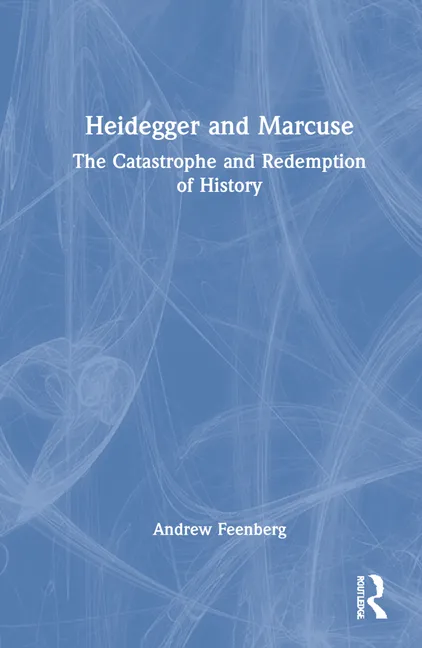
First published in 2005. Herbert Marcuse was Martin Heidegger's most famous student. He claimed to have left existentialism behind in 1933 when Heidegger was declared first Nazi rector of Freiburg University and Marcuse fled into exile.The contentious relations between these two thinkers reflected the split in twentieth-century continental philosophy between exist- entialism and Marxism. But Andrew Feenberg's careful study of Heidegger's early lectures, as well as of previously unpublished work by Marcuse, suggests that the famous student remained closer than he cared to admit to the even more famous teacher. Heidegger and Marcuse examines for the first time Marcuse's remarkable attemptsin his early and late work to bridge the gap between existentialism and Marxism in a radical critical theory.
Andrew Feenberg
Andrew Feenberg is an American philosopher. He is the author of Luk�cs, Marx and the Sources of Critical Theory( 1981), Critical Theory of Technology (1991), Alternative Modernity (1995), Questioning Technology (1999), When Poetry Ruled the Streets: The May Events of 1968 (2001), Transforming Technology (2002), Heidegger and Marcuse: The Catastrophe and Redemption of History (2005), Between Reason and Experience: Essays in Technology and Modernity (2010), The Philosophy of Praxis (2014), Technosystem: The Social Life of Reason (2017), and Nishida, Kawabata, and the Japanese Response to Modernity (2019).
More by Andrew Feenberg


Why Readwise Books?
Readwise Books is an ebook & audiobook platform that automatically logs how much you and your friends read, making it fun and easy to read more. Learn more →