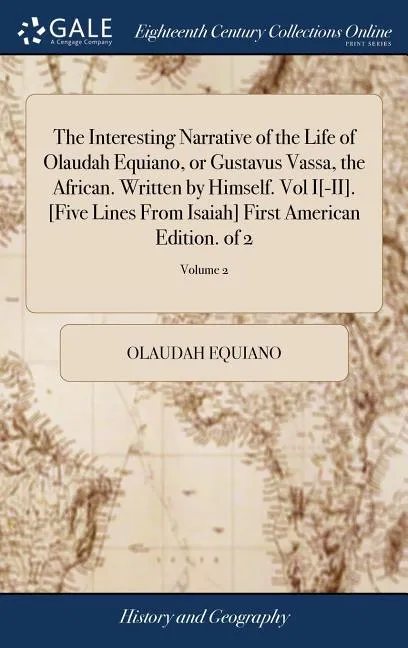
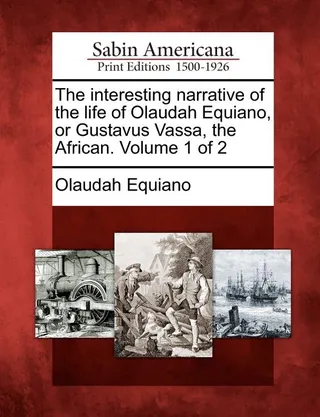
The Interesting Narrative of the Life of Olaudah Equiano, or Gustavus Vassa, the African. Written by Himself. Vol I[-II]. [Five Lines From Isaiah] First American Edition. of 2; Volume 2
Report an issue
Tell us what's wrong and we'll take a look.
Thanks – we got it. We'll review and follow up if needed.
The 18th century was a wealth of knowledge, exploration and rapidly growing technology and expanding record-keeping made possible by advances in the printing press. In its determination to preserve the century of revolution, Gale initiated a revolution of its own: digitization of epic proportions to preserve these invaluable works in the largest archive of its kind. Now for the first time these high-quality digital copies of original 18th century manuscripts are available in print, making them highly accessible to libraries, undergraduate students, and independent scholars.
Rich in titles on English life and social history, this collection spans the world as it was known to eighteenth-century historians and explorers. Titles include a wealth of travel accounts and diaries, histories of nations from throughout the world, and maps and charts of a world that was still being discovered. Students of the War of American Independence will find fascinating accounts from the British side of conflict.
++++
The below data was compiled from various identification fields in the bibliographic record of this title. This data is provided as an additional tool in helping to insure edition identification:
++++
British Library
W020545
[A]{4} B-R{6} S² ²B-R{6}. Plates engraved by Cornelius Tiebout. Errors in paging: p. 189, 192 misnumbered 199, 202. List of subscribers, p. [5-8].
New-York: Printed and sold by W. Durell, at his book-store and printing-office, no. 19, Q. Street, M, DCC, XCI. [1791] [8], 194; [2], 192 p., [2] leaves of plates (one folded): ill., 1 port.; 12°
Olaudah Equiano
Born in Nigeria in 1745, Olaudah Equiano was a well-known African abolitionist. Equiano was shipped to the West Indies as a child-slave, and then to England where he was purchased by Lieutenant Michael Pascal and trained as a seaman before serving in The Seven Years’ War. At the conclusion of hostilities, Pascal did not free Equiano as promised, but instead sold him to Captain James Doran who then sold Equiano to James King, a merchant from Philadelphia. In 1765, King let Equiano purchase his freedom for forty pounds, and helped him earn money in his stead as a merchant. Now a free man, Equiano returned to London where he made significant contributions to the abolitionist movement, and published his autobiography, The Interesting Narrative of the Life of Olaudah Equiano, or Gustavus Vassa, the African, which influenced the Slave Trade Act of 1807. Equiano is believed to have died in 1797 at the age of 52.
More by Olaudah Equiano


Why Readwise Books?
Readwise Books is an ebook & audiobook platform that automatically logs how much you and your friends read, making it fun and easy to read more. Learn more →