Report an issue
Tell us what's wrong and we'll take a look.
Thanks – we got it. We'll review and follow up if needed.
"The book provides a reference point for beginning educational researchers to grasp the most pertinent elements of designing and conducting research…"
—Megan Tschannen-Moran, The College of William & Mary
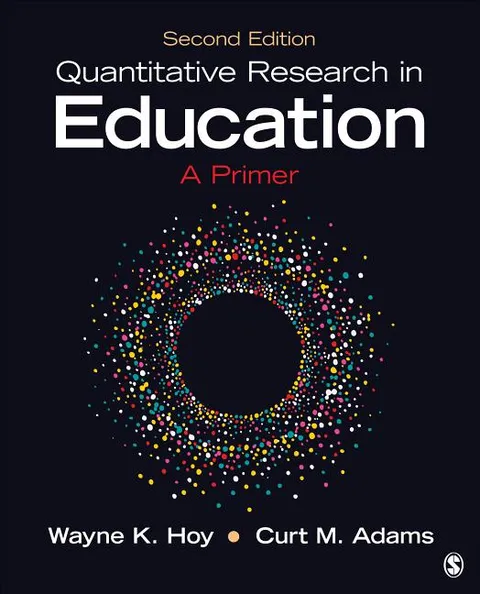
Quantitative Research in Education: A Primer, Second Edition is a brief and practical text designed to allay anxiety about quantitative research. Award-winning authors Wayne K. Hoy and Curt M. Adams first introduce readers to the nature of research and science, and then present the meaning of concepts and research problems as they dispel notions that quantitative research is too difficult, too theoretical, and not practical. Rich with concrete examples and illustrations, the Primer emphasizes conceptual understanding and the practical utility of quantitative methods while teaching strategies and techniques for developing original research hypotheses.
The Second Edition includes suggestions for empirical investigation and features a new section on self-determination theory, examples from the latest research, a concluding chapter illustrating the practical applications of quantitative research, and much more. This accessible Primer is perfect for students and researchers who want a quick understanding of the process of scientific inquiry and who want to learn how to effectively create and test ideas.

Curt M. Adams
Curt M. Adams is an associate professor of educational leadership and policy studies at the University of Oklahoma and co-director of the Oklahoma Center for Educational Policy. In 2014 he was awarded the Linda Clarke Anderson Presidential Professorship for outstanding contribution to the University, field, and community through research, teaching, and service. He conducts research on the social-psychology of school systems, performance measurement, accountability, and improvement science. He is past founder and director of the San Miguel School of Tulsa, a nonprofit, gratuitous school based on the Lasallian charism of serving socially deprived students and families. Recent publications include: Self-regulatory climate: A positive attribute of schools (Journal of Educational Research); Self-regulatory climate: A social resource for student regulation and achievement (Teachers College Record); Revisiting the collective trust effect in urban elementary schools (Educational Administration Quarterly); Collective trust: A social indicator of instructional capacity (Journal of Educational Administration); Parent social networks and parent responsibility: Implications for school leadership (Journal of School Leadership); and Collective trust: Why schools can’t improve without it (Teachers College Press).


Why Readwise Books?
Readwise Books is an ebook & audiobook platform that automatically logs how much you and your friends read, making it fun and easy to read more. Learn more →