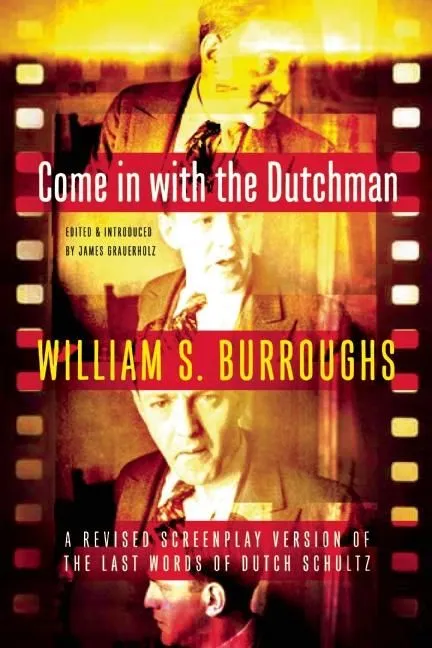
Come In with the Dutchman
A Revised Screenplay Version of The Last Words of Dutch Schultz
Report an issue
Tell us what's wrong and we'll take a look.
Thanks – we got it. We'll review and follow up if needed.
“Burroughs’s voice is hard, derisive, inventive, free, funny, serious, poetic, indelibly American.”—Joan Didion
The layered, idiosyncratic screenplay about one of America’s most notorious gangsters by one of its greatest counterculture icons, available to readers for the first time
Before he was gunned down in October 1935 in the Palace Chop House in Newark, New Jersey, Arthur Flegenheimer—alias Dutch Schultz—was considered New York’s number one racketeer. Schultz survived for two days after the shooting, in a hospital room that was guarded around the clock. A police stenographer was stationed at his bedside in the hope of learning the identity of his assailant, but instead, he recorded Dutch’s fevered fantasies, images from his childhood, youth, and his life of crime.
From these “last words,” William S. Burroughs created his own fantasia of Dutch Schultz, rife with the dark humor, surreal insight, and ferocious energy for which Burroughs is known. This unconventional script-style novel is one of Burroughs’ most accessible works, marrying the swagger of a classic gangster film with tender explorations of violence, addiction, and the precarity of a life on the margins.
Appearing in a newly edited and reworked version with an illuminating introduction from acclaimed Beat scholar James Grauerholz, Come In with the Dutchman is an exciting new version of one of Burroughs’s most layered and idiosyncratic projects.
William S Burroughs
William S. Burroughs (1914-1997) was an American author, painter, and spoken-word performer who has had a wide-ranging influence on American culture. Jack Kerouac called him the "greatest satirical writer since Jonathan Swift." Norman Mailer declared him "the only American writer who may be conceivably possessed by genius." A postmodernist and a key figure of the beat generation, he focused his art on a relentless subversion of the moral, political, and economic conventions of modern American society, as reflected in his often darkly humorous and sardonic satire. He wrote eighteen novels and novellas, six short-story collections, and four collections of essays.
More by William S Burroughs





Why Readwise Books?
Readwise Books is an ebook & audiobook platform that automatically logs how much you and your friends read, making it fun and easy to read more. Learn more →