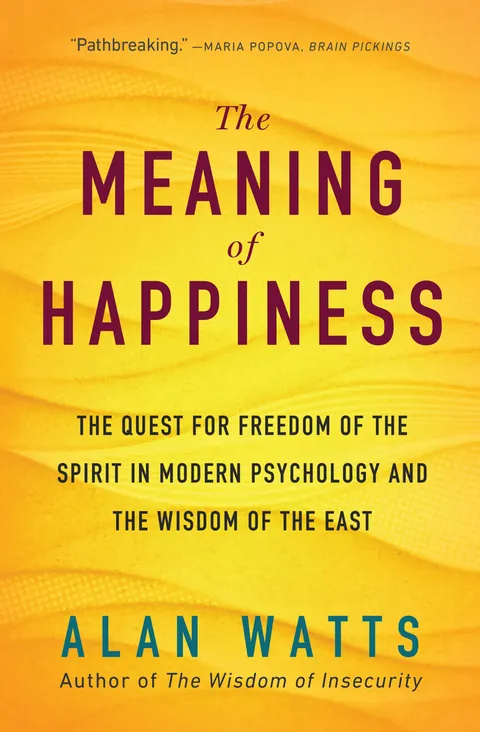
The Meaning of Happiness
The Quest for Freedom of the Spirit in Modern Psychology and the Wisdom of the East
Report an issue
Tell us what's wrong and we'll take a look.
Thanks – we got it. We'll review and follow up if needed.
Deep down, most people think that happiness comes from having or doing something. Here, in Alan Watts's groundbreaking third book (originally published in 1940), he offers a more challenging thesis: authentic happiness comes from embracing life as a whole in all its contradictions and paradoxes, an attitude that Watts calls the "way of acceptance." Drawing on Eastern philosophy, Western mysticism, and analytic psychology, Watts demonstrates that happiness comes from accepting both the outer world around us and the inner world inside us -- the unconscious mind, with its irrational desires, lurking beyond the awareness of the ego. Although written early in his career, The Meaning of Happiness displays the hallmarks of his mature style: the crystal-clear writing, the homespun analogies, the dry wit, and the breadth of knowledge that made Alan Watts one of the most influential philosophers of his generation.
Alan Watts
Alan Watts published over 25 books, including The Book: On the Taboo Against Knowing Who You Are, The Way of Zen and Tao: The Watercourse Way.
He was a philosopher, academic and theologian, who wrote and spoke widely on Asian philosophy and theology. He is best known as an interpreter of Zen Buddhism in particular, and of Indian and Chinese philosophy in general. He was the author of more than twenty books on the philosophy and psychology of religion. He died in 1973.
More by Alan Watts








Why Readwise Books?
Readwise Books is an ebook & audiobook platform that automatically logs how much you and your friends read, making it fun and easy to read more. Learn more →