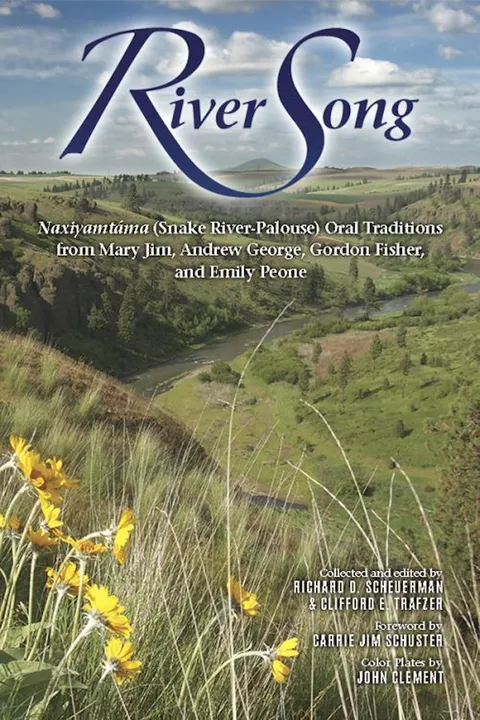
River Song
Naxiyamtáma (Snake River-Palouse) Oral Traditions from Mary Jim, Andrew George, Gordon Fisher, and Emily Peone
Report an issue
Tell us what's wrong and we'll take a look.
Thanks – we got it. We'll review and follow up if needed.
For generations, the original Snake River-Palouse people lived a free, open life on the Columbia Plateau, moving on horseback from the Snake River to Badger Mountain to Oregon's Blue Mountains. They interacted and intermarried within a vast region, and their stories are rich in content, interpretation, and nuance. Denied a place on their ancestral lands, most relocated to Nez Perce, Umatilla, Warm Springs, Yakama, and Colville reservations, where maintaining their cultural identity became increasingly difficult. Still, elders continued to pass down oral histories, insisting youngsters listen with rapt attention.
Beginning in the 1970s, Naxiyamtáma elders--in particular Mary Jim, Andrew George, Gordon Fisher, and Emily Peone--shared their stories with a research team. They hoped to teach American Indian history in a traditional manner and refute incorrect versions. Multiple themes emerged--a pervasive spirituality tied to the Creator and environment; a covenant relationship and sacred trust to protect and preserve their traditional lands; storytelling as a revered art form that reveals life lessons; and finally, belief in cyclical time and blood memory.
Tied to Plateau people's leadership families, the featured elders had lived in the traditional way--gathering, hunting, and fishing, participating in the ancient Wáshani religion, and honoring the Creator through First Food ceremonies. In their retelling, the authors endeavored to capture their original voices and stay true to Snake River-Palouse oral traditions. Creation stories include "Why Coyote Made the Palouse Hills," and "The Origin of Palouse Falls." Although narratives by other groups are similar to Mary Jim's "How Coyote Learned to Fish," and Gordon Fisher's "How Beaver Brought Fire to the People," their versions offer a distinct Naxiyamtáma perspective. The authors also describe their method and approach--one that will serve as a model for conducting Native American cultural research.
Richard D Scheuerman
Retired Seattle Pacific University Associate Professor Dr. Richard D. Scheuerman grew up on a small Palouse Country farm between Endicott and St. John, Washington. He holds a Ph.D. in Educational Leadership from Gonzaga University, an M.A. in History from Pacific Lutheran University, and a B.A. in History and Education from Washington State University. The co-author of more than ten books on Pacific Northwest history, he has received the Washington State Historical Society's Robert Gray Medal, the Washington Governor's Award for Excellence in Teaching, a Schneidmiller Foundation grant, and the University of California-Riverside Rupert Costo Medallion for Research in Native American History.
Clifford E Trafzer
Clifford E. Trafzer is the Distinguished Professor of History and the Rupert Costo Chair in American Indian Affairs at the University of California-Riverside.


Why Readwise Books?
Readwise Books is an ebook & audiobook platform that automatically logs how much you and your friends read, making it fun and easy to read more. Learn more →