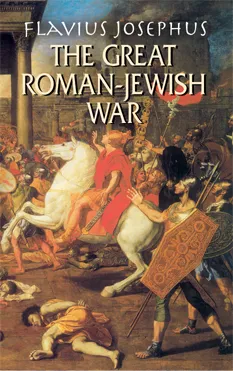
The Great Roman-Jewish War
Report an issue
Tell us what's wrong and we'll take a look.
Thanks – we got it. We'll review and follow up if needed.
An eyewitness account of a historical turning point in Judaism, Christianity, and all of Western civilization, The Great Roman-Jewish War chronicles the Jewish revolt against the Roman Empire from A.D. 66–70. Its author was a leader among the Jewish resistance in Roman occupied Judea during the first century — until he switched sides and collaborated with Rome, becoming an adopted member of the imperial family and assuming the name Flavius Josephus.
For centuries, Flavius Josephus’ histories of the tumultuous era that saw the collapse of Jewish independence and the rise of Christianity were more widely read in Europe than any book other than the Bible. The Great Roman-Jewish War is among the few sources of information about Judaism during the first century. As such, it provides an essential background for an understanding of both the beginning of modern Judaism and of the New Testament within its historical setting. It also offers a fascinating self-portrait of a turncoat general whose story is as much a rationale for his collaboration as it is a record of events.
This edition features a detailed biographical sketch of the author as well as appendixes with helpful maps, genealogies, and a chronological table.
Flavius Josephus
Flavius Josephus was a Roman-Jewish historian and military officer who lived from around AD 37 to around 100. He was born in Jerusalem, then part of the Roman province of Judea, to a priestly father and a royal mother. He is best known for his novel The Jewish War. He initially fought against the Roman Empire as the general of the Jewish armies in Galilee during the First Jewish-Roman War, until surrendering in 67 AD to the Roman army led by military commander Vespasian following a six-week siege of Yodfat. According to Josephus, the Jewish messianic prophecies that sparked the First Jewish-Roman War mentioned Vespasian becoming Roman emperor. As a result, Vespasian opted to keep Josephus as a slave and interpreter. When Vespasian became Emperor in AD 69, he awarded Josephus his freedom, and he took the Emperor's surname of Flavius. Flavius Josephus surrendered completely to the Romans and was granted Roman citizenship. When Titus led the siege of Jerusalem in 70 AD, he became an advisor and companion of Vespasian's son Titus, working as his translator. After the siege failed to quell the Jewish insurrection, the city was pillaged, and Herod's Temple (the Second Temple) was looted and destroyed.
More by Flavius Josephus


Why Readwise Books?
Readwise Books is an ebook & audiobook platform that automatically logs how much you and your friends read, making it fun and easy to read more. Learn more →