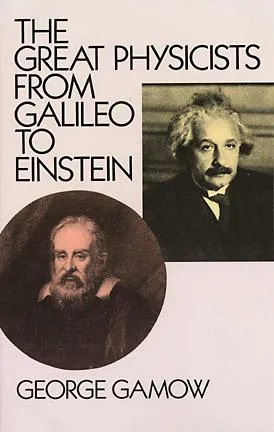
The Great Physicists from Galileo to Einstein
Report an issue
Tell us what's wrong and we'll take a look.
Thanks – we got it. We'll review and follow up if needed.
"This book is Gamow at his best, which means the very best in science for the layman." — Library Journal
Widely recognized as one of the 20th century's foremost physicists, George Gamow was also an unusually capable popularizer of science. His talents are vividly revealed in this exciting and penetrating explanation of how the central laws of physical science evolved — from Pythagoras' discovery of frequency ratios in the 6th century B.C. to today's research on elementary particles.
Unlike many books on physics which focus entirely on fact and theory with little or no historic detail, the present work incorporates fascinating personal and biographical data about the great physicists of past and present. Thus Dr. Gamow discusses on an equal basis the trail of Galileo and the basic laws of mechanics which he discovered, or gives his personal recollections about Niels Bohr along with detailed discussion of Bohr's atomic model. You'll also find revealing glimpses of Newton, Huygens, Heisenberg, Pauli, Einstein, and many other immortals of science.
Each chapter is centered around a single great figure, or at most two, with other physicists of the era and their contributions forming a background. Major topics include the dawn of physics, the Dark Ages and the Renaissance, Newtonian physics, heat as energy, electricity, the relativistic revolution, quantum theory, and the atomic nucleus and elementary particles.
As Dr. Gamow points out in the Preface, the aim of this book is to give the reader the feeling of what physics is, and what kind of people physicists are. This delightfully informal approach, combined with the book's clear, easy-to-follow explanations, will especially appeal to young readers but will stimulate and entertain science enthusiasts of all ages. 1961 edition.
"The whole thing is a tour de force covering all the important landmarks." — Guardian
George Gamow
George Gamow (1904-1968), was a Russian-born American nuclear physicist and cosmologist who was one of the foremost advocates of the big-bang theory, according to which the universe was formed in a colossal explosion that took place billions of years ago. Gamow attended Leningrad (now St. Petersburg) University, where he studied briefly with A.A. Friedmann, a mathematician and cosmologist who suggested that the universe should be expanding. At that time Gamow did not pursue Friedmann's suggestion, preferring instead to delve into quantum theory. After graduating in 1928, he traveled to Göttingen, where he developed his quantum theory of radioactivity, the first successful explanation of the behaviour of radioactive elements. In 1934, after emigrating from the Soviet Union, Gamow was appointed professor of physics at George Washington University in Washington, D.C. There he collaborated with Edward Teller in developing a theory of beta decay (1936), a nuclear decay process in which an electron is emitted. In 1954 Gamow's scientific interests grew to encompass biochemistry. He proposed the concept of a genetic code and maintained that the code was determined by the order of recurring triplets of nucleotides, the basic components of DNA. His proposal was vindicated during the rapid development of genetic theory that followed. Gamow held the position of professor of physics at the University of Colorado, Boulder, from 1956 until his death. He is perhaps best known for his popular writings, designed to introduce to the non-specialist such difficult subjects as relativity and cosmology. His first such work, Mr. Tompkins in Wonderland (1939), gave rise to the multivolume Mr. Tompkins series (1939-67). Among his other writings are One, Two, Three...Infinity (1947), The Creation of the Universe (1952), A Planet Called Earth (1963), and A Star Called the Sun (1964).
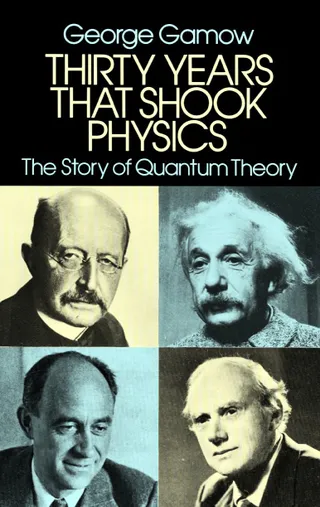
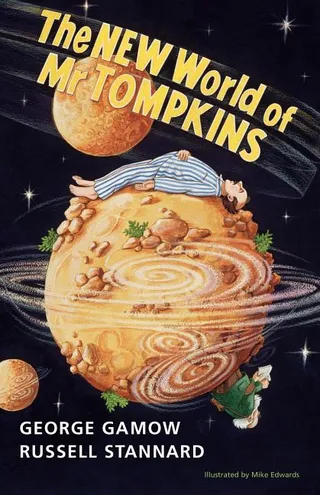
More by George Gamow


Why Readwise Books?
Readwise Books is an ebook & audiobook platform that automatically logs how much you and your friends read, making it fun and easy to read more. Learn more →