Report an issue
Tell us what's wrong and we'll take a look.
Thanks – we got it. We'll review and follow up if needed.
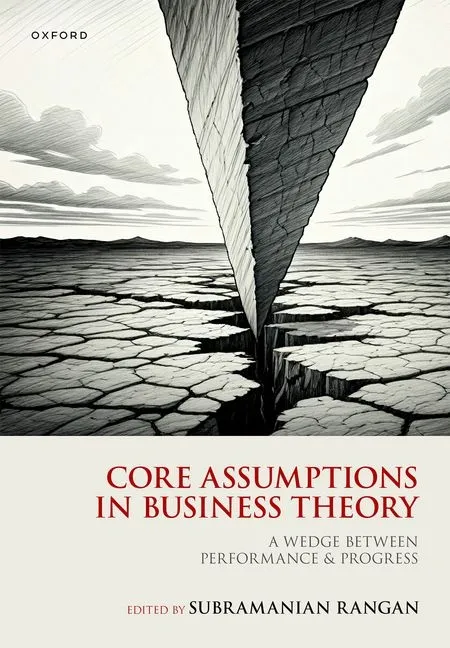
Beyond regulation and the practice of business, we must attend as well to education and the theory of business. In particular, we must look at business theory's core assumptions, whose weaknesses are long known. In an applied field such as business, where theory tends to be normative, flawed assumptions could act as a "wedge" cleaving apart performance and progress.
In this volume, Subramanian Rangan brings together eminent social scientists and philosophers to explore core assumptions in each of the major fields of business-including economics, strategy, marketing, operations, decision science, leadership, governance, technology, and finance. This structured field-by-field reflection reveals and expands the bounds of our rationality. Core Assumptions in Business Theory proposes a revised profit function that integrates harm, outlines how economic actors may draw on moral philosophy to enact Pareto-equity (and not just Pareto-efficiency), suggests a two-stage rationality approach that can attend to well-being, and recasts marketing as consumer education and not merely demand promotion.
With an emphasis on education rather than regulation of economic power, this volume argues that moral reasoning and moral roles can fruitfully supplement prudential reasoning and functional responsibilities. Such an evolution will enable our economy to be both modern and moral.
This is an open access title available under the terms of a CC BY-NC-ND 4.0 International licence. It is free to read on the Oxford Academic platform and offered as a free PDF download from OUP and selected open access locations.


Why Readwise Books?
Readwise Books is an ebook & audiobook platform that automatically logs how much you and your friends read, making it fun and easy to read more. Learn more →