Report an issue
Tell us what's wrong and we'll take a look.
Thanks – we got it. We'll review and follow up if needed.
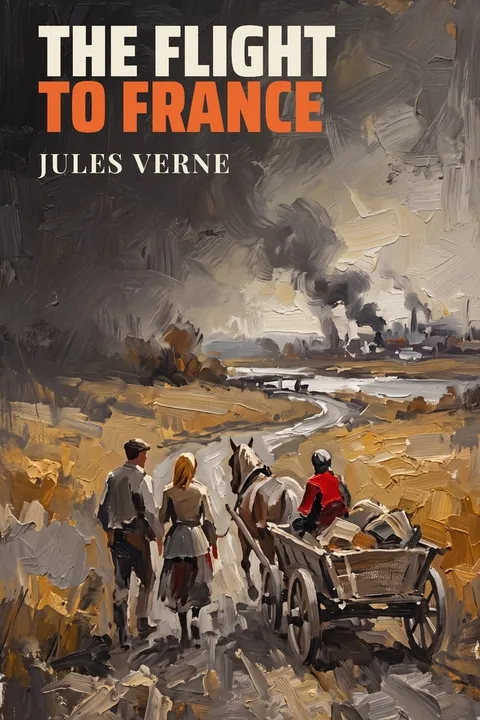
His mission is simple but nearly impossible: return to France across hundreds of miles controlled by Austrian and Prussian forces determined to crush the Revolution. But Natalis doesn't travel alone. He's responsible for protecting others-civilians, fellow soldiers, people whose survival depends on his resourcefulness and determination.
The landscape itself has become weaponized. Roads that once connected communities are now zones of danger. Borders that were administrative lines have become militarized frontiers. Villages change hands weekly, their inhabitants forced to navigate lethal uncertainties about which authority to acknowledge, which soldiers to trust, which political allegiance might mean survival or death.
Jules Verne published The Flight to France (Le Chemin de France) in 1887, two years before the Revolution's centennial, when France remained bitterly divided about revolutionary legacy. He set his novel at 1792's inflection point-after the monarchy's fall but before the Terror, when war was just beginning and the Revolution's outcome remained uncertain.
What emerges isn't straightforward adventure or simple revolutionary heroism. Verne shows the Revolution's messy realities: requisitions that impoverish civilians, violence that spirals beyond control, the dissolution of bonds that once held communities together. Yet he also recognizes what drove ordinary people to risk everything for republican principles-the ancien régime's brutality, the systematic injustices that made radical transformation feel necessary.
Natalis fights for the Revolution while navigating its contradictions. His loyalty isn't to ideological purity but to France itself-a distinction that matters crucially as he encounters people with radically different stakes in the Revolution's success or failure.
This is late-period Verne: politically engaged, historically grounded, willing to acknowledge moral complexity rather than offering easy answers. For readers interested in how the nineteenth century understood its defining political upheaval, or in Verne's capacity to write about war's human cost beyond adventure formula, The Flight to Franceoffers something rare-a novel that takes both revolutionary ideals and their messy implementation seriously.
Jules Verne
Jules Verne (1828-1905) used a combination of scientific facts and his imagination to take readers on extraordinary imaginative journeys to fantastic places. In such books as Around the World in Eighty Days, From the Earth to the Moon, and Journey to the Center of the Earth, he predicted many technological advances of the twentieth century, including the invention of the automobile, telephone, and nuclear submarines, as well as atomic power and travel to the moon by rocket.
More by Jules Verne









Why Readwise Books?
Readwise Books is an ebook & audiobook platform that automatically logs how much you and your friends read, making it fun and easy to read more. Learn more →