Report an issue
Tell us what's wrong and we'll take a look.
Thanks – we got it. We'll review and follow up if needed.
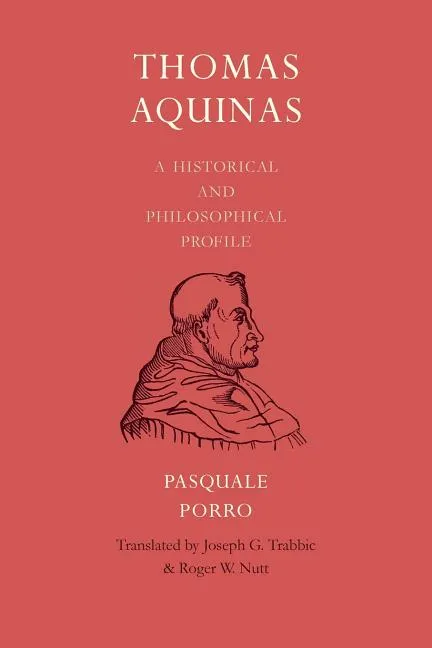
The development of ideas in Thomas Aquinas's philosophical thinking has been the subject of numerous smaller studies, but no contemporary work in the English-speaking world covers his every single work in chronological order in terms of philosophical development, influences, manuscript evidence, and historical setting. In Thomas Aquinas: A Historical and Philosophical Profile, Pasquale Porro has provided a complete landscape of Thomas's corpus that will give Thomistic scholars and students an invaluable reference point for research, discussion, and debate.
Porro's chronological approach contrasts with the systematic and thematic approach of existing summaries of Thomas's -philosophy, - many of which provided only the thinnest historical contextualization and minimal accounts of influences. Beginning with the De principiis naturae and the De ente et essentia, composed while Thomas was still a young -bachelor of the Sentences, - and concluding with a letter to the abbot of Monte Cassino, written shortly before his death in 1274, Porro meticulously sets each of the Angelic Doctor's writings in its unique historical context, indicating developments and changes of mind, and extensively analyzing the full range of philosophical influences - from Aristotle, Augustine, Proclus, and Pseudo-Dionysius to Maimonides, Avicenna, and Averroes, among others. Throughout the book he offers commentary on the existence and state of manuscripts and critical editions of Thomas's various texts, giving the reader a glimpse of the condition of the primary sources available to scholars. As he moves from one writing to the next, Porro also presents a finely wrought portrait of the Dominican master's life. Unlike many expositions of Thomas's thought, which relegate his biography to an introductory chapter, Porro works the biographical details into his interpretation of the texts, making them an essential part of his account of the historical circumstances in which Thomas wrote, thereby enhancing the reader's understanding of his texts.
Porro's interpretation of the philosophical dimension of Thomas's work challenges certain prevalent twentieth century interpretations on such topics as epistemological realism, the relationship between essence and existence, and creaturely contingency. Nevertheless, even scholars who disagree with him on particular points will have much to gain from this meticulously-researched and clearly-written study.
Roger W Nutt
Translated by
Roger W. Nutt is Associate Professor of Theology at Ave Maria University in Ave Maria, Florida, where he lives with his wife and son.


Why Readwise Books?
Readwise Books is an ebook & audiobook platform that automatically logs how much you and your friends read, making it fun and easy to read more. Learn more →