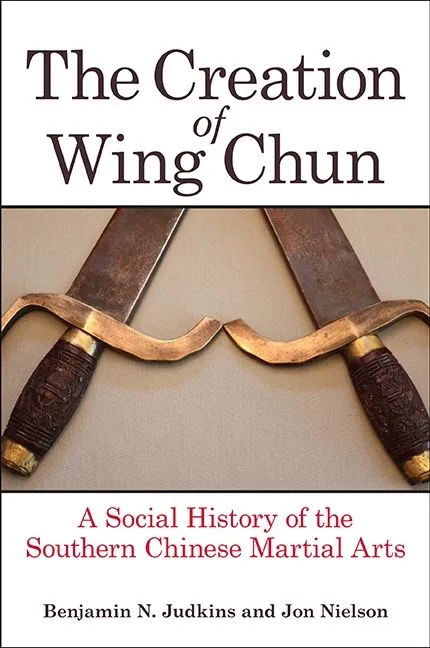
The Creation of Wing Chun
A Social History of the Southern Chinese Martial Arts
Report an issue
Tell us what's wrong and we'll take a look.
Thanks – we got it. We'll review and follow up if needed.
Looks at southern Chinese martial arts traditions and how they have become important to local identity and narratives of resistance.
This book explores the social history of southern Chinese martial arts and their contemporary importance to local identity and narratives of resistance. Hong Kong's Bruce Lee ushered the Chinese martial arts onto an international stage in the 1970s. Lee's teacher, Ip Man, master of Wing Chun Kung Fu, has recently emerged as a highly visible symbol of southern Chinese identity and pride. Benjamin N. Judkins and Jon Nielson examine the emergence of Wing Chun to reveal how this body of social practices developed and why individuals continue to turn to the martial arts as they navigate the challenges of a rapidly evolving environment. After surveying the development of hand combat traditions in Guangdong Province from roughly the start of the nineteenth century until 1949, the authors turn to Wing Chun, noting its development, the changing social attitudes towards this practice over time, and its ultimate emergence as a global art form.
Jon Nielson
Jon Nielson (DMin, Trinity Evangelical Divinity School) serves as the senior pastor of Christ Presbyterian Church of Wheaton in Wheaton, Illinois. He is coeditor of the book Gospel-Centered Youth Ministry and author of the Theology Basics series. He and his wife, Jeanne, have four children.
More by Jon Nielson









Why Readwise Books?
Readwise Books is an ebook & audiobook platform that automatically logs how much you and your friends read, making it fun and easy to read more. Learn more →