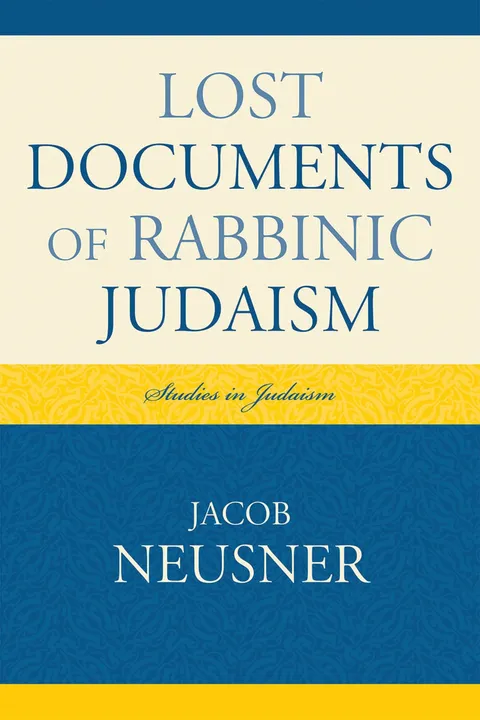
Lost Documents of Rabbinic Judaism
Report an issue
Tell us what's wrong and we'll take a look.
Thanks – we got it. We'll review and follow up if needed.
The canonical documents of Rabbinic Judaism impose upon most of their components fixed patterns of rhetoric, recurrent logic of coherent discourse, and a well-defined topic or program, for example, a commentary on a biblical book or on a legal topic. But some few compositions and composites of the Rabbinic canon of late antiquity diverge from the formal norms of the compilations in which they occur. In these pages, Neusner assembles anomalous compositions that occur in the Mishnah, Tosefta, four Tannaite Midrashim, and Genesis Rabbah, and he further tests the uniformity of the forms that govern in a familiar chapter of the Bavli. Neusner's surveys show for the documents probed here that some small segment of the composites and compositions of the surveyed documents does not conform to the indicative rules of rhetoric, topic, and logic. Consequently, we face the challenge of constructing models of lost documents of the Rabbinic canon, conforming to the models governing anomalous compositions. These follow other topical and rhetorical norms and therefore belong in other, different types of documents from those in which they now are located. These anomalous writings in topic, logic, or rhetoric (or all three) in theory reveal indicative characteristics other than the ones defining the compositions and composites of the documents in which they are now located.
Jacob Neusner
Jacob Neusner is Distinguished Service Professor of the History and Theology of Judaism; Senior Fellow, Institute of Advanced Theology, Bard College, in Annandale-on-Hudson, New York.
More by Jacob Neusner


Why Readwise Books?
Readwise Books is an ebook & audiobook platform that automatically logs how much you and your friends read, making it fun and easy to read more. Learn more →