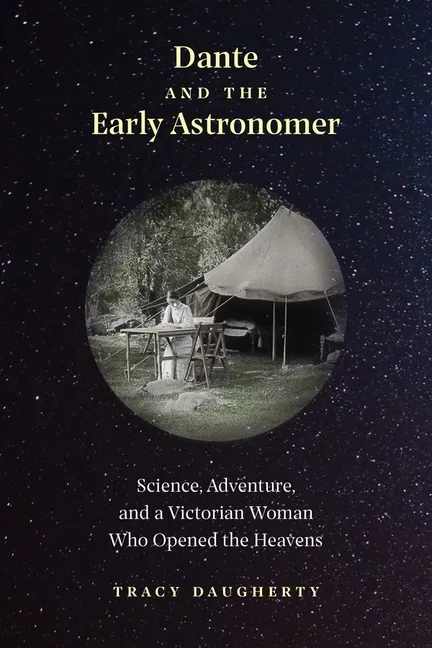
Dante and the Early Astronomer
Science, Adventure, and a Victorian Woman Who Opened the Heavens
Report an issue
Tell us what's wrong and we'll take a look.
Thanks – we got it. We'll review and follow up if needed.
In 1910, Mary Acworth Evershed (1867-1949) sat on a hill in southern India staring at the moon as she grappled with apparent mistakes in Dante's Divine Comedy. Was Dante's astronomy unintelligible? Or was he, for a man of his time and place, as insightful as one could be about the sky?
As the twentieth century began, women who wished to become professional astronomers faced difficult cultural barriers, but Evershed joined the British Astronomical Association and, from an Indian observatory, became an experienced observer of sunspots, solar eclipses, and variable stars. From the perspective of one remarkable amateur astronomer, readers will see how ideas developed during Galileo's time evolved or were discarded in Newtonian conceptions of the cosmos and then recast in Einstein's theories. The result is a book about the history of science but also a poetic meditation on literature, science, and the evolution of ideas.
Tracy Daugherty
Born and raised in Texas, Tracy Daugherty (he/him) is the author of over ten novels and short story collections, a memoir, a book of personal essays, a collection of essays on writing, a novella collection, and several literary biographies. His 2009 biography of Donald Barthelme, Hiding Man, was a New York Times and New Yorker Notable Book, and his 2015 biography of Joan Didion, The Last Love Song was a New York Times Bestseller. His work has been recognized by the Guggenheim Foundation and the National Endowment for the Arts. At Oregon State University he helped found the MFA Program in Creative Writing.
More by Tracy Daugherty






Why Readwise Books?
Readwise Books is an ebook & audiobook platform that automatically logs how much you and your friends read, making it fun and easy to read more. Learn more →