Report an issue
Tell us what's wrong and we'll take a look.
Thanks – we got it. We'll review and follow up if needed.
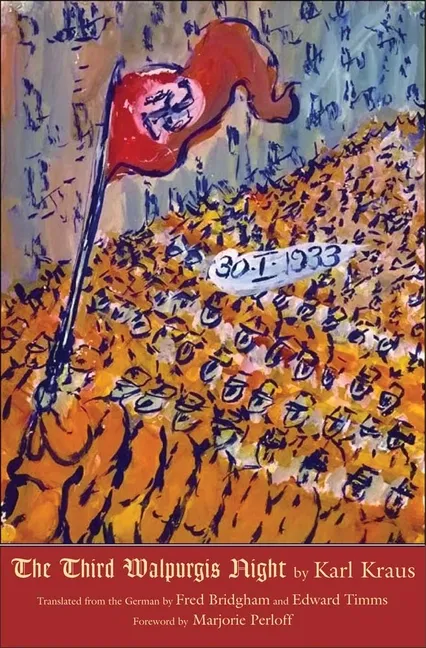
"[A] drop-dead analysis of the rhetorical barbarities of the Hitler cult."--Bill Marx, Arts Fuse
Austrian satirist and polemicist Karl Kraus's Third Walpurgis Night was written in immediate response to the Nazi seizure of power in 1933 but was withheld from publication for fear of reprisals against Jews trapped in Germany. Acclaimed when finally published by Kösel Verlag in 1952, it is a devastatingly prescient exposure, giving special attention to the regime's corruption of language as masterminded by Joseph Goebbels. Bertolt Brecht wrote to Kraus that, in his indictment of Nazism, "you have disclosed the atrocities of intonation and created an ethics of language." This masterful translation, by the prizewinning translators of Kraus's The Last Days of Mankind, aims for clarity where Kraus had good reason to be cautious and obscure.
The Austrian Jewish author Karl Kraus (1874-1936) was the foremost German-language satirist of the twentieth century. As editor of the journal Die Fackel (The Torch) he single-handedly after 1912 conducted a sustained critique of propaganda and the press, expressed through polemical essays, satirical plays, witty aphorisms, and resonant poems.
Karl Kraus
Karl Kraus (1874-1936) was an Austrian satirist, playwright, poet, aphorist, and journalist. From 1899 until his death, he published the literary and political review Die Fackel.
More by Karl Kraus




Fred Bridgham
Translated by
Frederick G.T. Bridgham is Senior Lecturer in German at the University of Leeds.


Why Readwise Books?
Readwise Books is an ebook & audiobook platform that automatically logs how much you and your friends read, making it fun and easy to read more. Learn more →