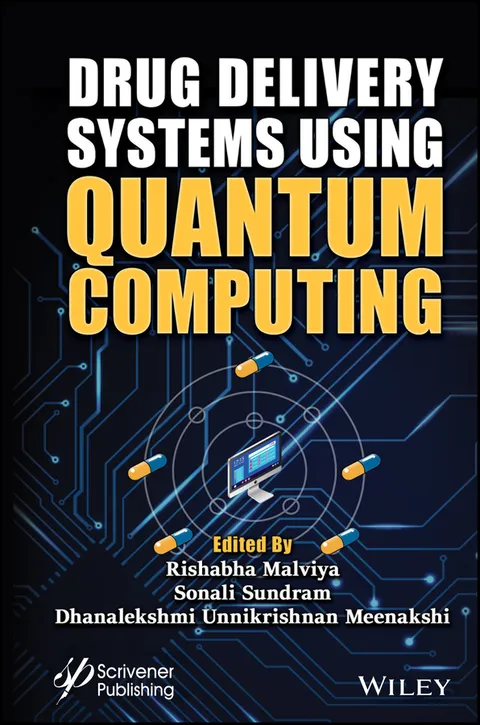
Drug Delivery Systems using Quantum Computing
Report an issue
Tell us what's wrong and we'll take a look.
Thanks – we got it. We'll review and follow up if needed.
The first book of its kind to show the potential of quantum computing in drug delivery.
Drug delivery systems (DDS) are defined as methods by which drugs are delivered to desired tissues, organs, cells, and subcellular organs for drug release and absorption through a variety of drug carriers. By controlling the precise level and/or location of a given drug in the body, side effects are reduced, doses are lowered, and new therapies are possible. Nevertheless, there are still significant obstacles to delivering certain medications to particular cells. Drug delivery methods change pharmacokinetic, pharmacodynamic, and drug release patterns to enhance product efficacy and safety, as well as patient convenience and compliance. Computational approaches in drug development enable quick screening of a vast chemical library and identification of possible binders by using modeling, simulation, and visualization tools. Quantum computing (QC) is a fundamentally new computing paradigm based on quantum mechanics rules that enables certain computations to be conducted significantly more rapidly and effectively than regular computing, and hence this has huge promise for the pharmaceutical sector.
Significant advances in computational simulation are making it easier to comprehend the process of drug delivery. This book explores an important biophysical component of DDSs, and how computer modeling may help with the logical design of DDSs with enhanced and optimized characteristics. The book concentrates on computational research for various important types of nanocarriers, including dendrimers and dendrons, polymers, peptides, nucleic acids, lipids, carbon-based DDSs, and gold nanoparticles.
Audience
Researchers and industry scientists working in clinical research and disease management; pharmacists, formulation and pharmaceutical scientists working in R&D; computer science engineers applying deep learning and quantum computing in healthcare.
Rishabha Malviya
Rishabha Malviya, did his PhD (Pharmacy) work in the area of novel formulation development techniques. He has 12 years of research experience and presently works as an Associate Professor in the Department of Pharmacy, School of Medical and Allied Sciences, Galgotias University. His area of research interest includes formulation optimization, nano formulation, nanorobotic targeted drug delivery, localized drug delivery and characterization of natural polymers as pharmaceutical drugs. He has authored more than 200 research/review papers for national/international journals of repute. He has 51 patents and has received an Outstanding Reviewer award from Elsevier. He has authored/edited/editing more than 70 books (Wiley, CRC Press, Springer Nature, River Publishers, De Gryuter, IOP publishing, Nova Science Publishers and Apple Academic Press) and authored 125 book chapters. His name is included in the world's top 2% of scientists in 2020, 2021 and 2022 by Elsevier and Stanford University.


Why Readwise Books?
Readwise Books is an ebook & audiobook platform that automatically logs how much you and your friends read, making it fun and easy to read more. Learn more →