Report an issue
Tell us what's wrong and we'll take a look.
Thanks – we got it. We'll review and follow up if needed.
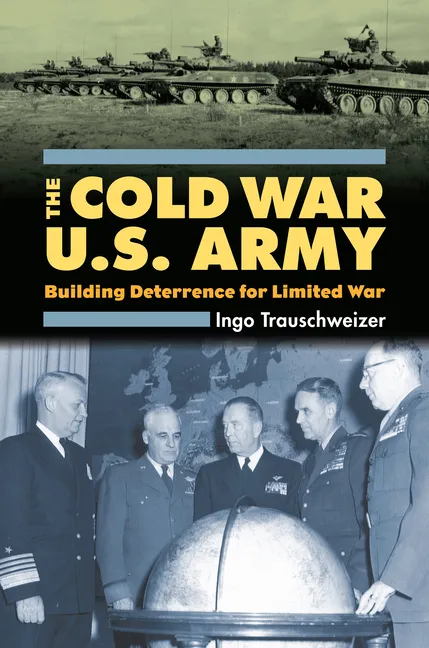
Trauschweizer describes how, beginning in the 1950s, the army faced an unprecedented problem: how to maintain a combat-ready fighting force that could operate on both conventional and nuclear battlefields. Faced with shifting threats to national security, budgetary battles, and unstable political developments around the globe, the army also had to keep abreast of new weaponry while navigating changes in its own top brass and the presidency.
Trauschweizer particularly considers the army's organizational and doctrinal response to problems posed by deterrence in Europe, focusing on the evolving role of the Seventh Army in West Germany-the largest and best-prepared field army the U.S. had ever deployed in peacetime. He explores the roles of Generals Matthew Ridgway, Maxwell Taylor, and others, as well as the use role of tactical nuclear weapons, as he traces the army's transformation through the New Look policy, pentomic reorganization, and the adoption of the ROAD concept.
Ultimately, Trauschweizer contends, the army found it impossible to prepare for limited war in the Third World while pursuing its primary mission of deterrence in Europe. His revisionist argument about the army's objectives in the 1960s and early 1970s places the Vietnam War in the context of the wider Cold War, offering new lines of inquiry into both. He also shows how, after the debacle of Vietnam, the army's sense of mission, technological evolution, organizational structure, and operational doctrine matured to produce the AirLand Battle doctrine of 1982, the cornerstone of our defense of Europe until the Cold War finally ended.
The U.S. Army's evolution during the 1950s and its role in Europe throughout the Cold War have remained two of the most neglected subjects in American military history. By covering the interaction of strategy, organization, doctrine, and technology in the army during this era--as well as the relationship between army doctrine and U.S./NATO defense strategy--The Cold War U.S. Army marks a major contribution to our understanding of both subjects.
Ingo Trauschweizer
Ingo Trauschweizer is a professor of history at Ohio University. He is the author of The Cold War U.S. Army: Building Deterrence for Limited War (Lawrence: University Press of Kansas, 2008) and Maxwell Taylor’s Cold War: From Berlin to Vietnam (Lexington: University Press of Kentucky, 2019), and he is the editor or co-editor of three volumes in the Baker Series in Peace and Conflict Studies (Athens: Ohio University Press).
More by Ingo Trauschweizer


Why Readwise Books?
Readwise Books is an ebook & audiobook platform that automatically logs how much you and your friends read, making it fun and easy to read more. Learn more →