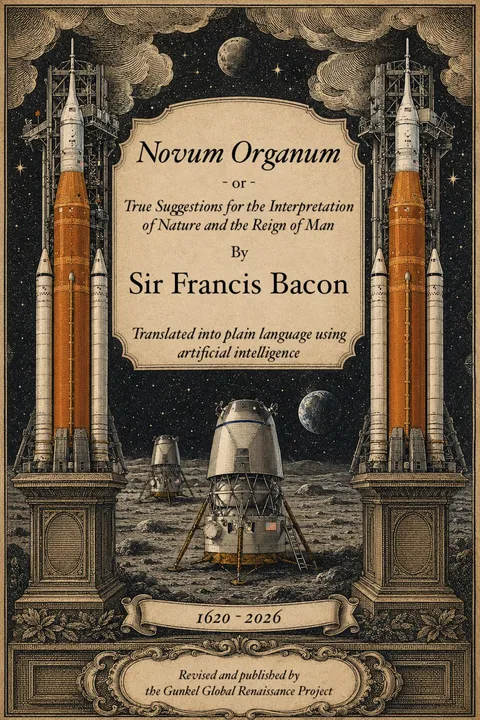
Novum Organum (Plain Language Translation)
True Suggestions for the Interpretation of Nature and the Reign of Man
Report an issue
Tell us what's wrong and we'll take a look.
Thanks – we got it. We'll review and follow up if needed.
This is a modern update to a very old book. Published in 1620, before Isaac Newton discovered the secret of gravity and launched our modern world, Novum Organum provides remarkable insight into the minds of men-and yes, they were basically all men-at the dawn of the Scientific Revolution. Sir Francis Bacon (1561 - 1626), the pioneering English philosopher and statesman who wrote Novum Organum, embodied the growing realization among Scientific Revolution-era scholars that nature was not random.
Bacon was convinced that with enough concentration and effort, human beings could figure out nature's rules and make stupendous discoveries. In Novum Organum, Bacon proposed a method to do just this.
"Looking back," English philosopher C.D. Broad has written, "we can see that [Bacon] was right, and we may be tempted to think that it was obvious. But it was not in the least obvious at the time; it was, on the contrary, a most remarkable feat of insight and act of rational faith in the face of present appearances and past experience."
This is a plain language translation of Francis Bacon's Novum Organum--the one book that, more than any other, helped lay the foundation for our modern scientific world.
Produced by the Gunkel Global Renaissance Project, the translation is intended to help contextualize the insights of Patrick Gunkel (1947 - 2017), the American futurist who founded ideonomy, a combinatorial science of ideas.
So get ready to be transported back in time and space, to a period when the Scientific Revolution was like the dawn brightening the sky in the east.
It was a world that-although very different from our own in some ways-will bear other many similarities, for more or less the reason that Gunkel identified: we have not taken Bacon's ideas far enough and are still, to some extent, intellectually stuck in the 17th century when it comes to the systematic investigation of ideas.
Francis Bacon
Francis Bacon (1561-1626) was an English philosopher, statesman, and scientist who is considered one of the most influential thinkers of the early modern period. He was born in London to a prominent family and received a classical education at Trinity College, Cambridge. Bacon's early career was marked by his work as a lawyer and his rise through the ranks of government, eventually becoming Lord Chancellor under King James I. However, he is best known for his contributions to philosophy and science. Bacon is often credited with developing the scientific method, which emphasizes empirical observation and experimentation as the basis for knowledge. His major works include "Novum Organum," which outlines his new method of inquiry, and "The Advancement of Learning," which argues that the pursuit of knowledge is essential for human progress. Despite his many accomplishments, Bacon's career was marred by scandal and controversy, including accusations of corruption during his time as Lord Chancellor. Nevertheless, his ideas and legacy continue to be studied and debated today.
More by Francis Bacon



Why Readwise Books?
Readwise Books is an ebook & audiobook platform that automatically logs how much you and your friends read, making it fun and easy to read more. Learn more →