Novum Organum
Report an issue
Tell us what's wrong and we'll take a look.
Thanks – we got it. We'll review and follow up if needed.
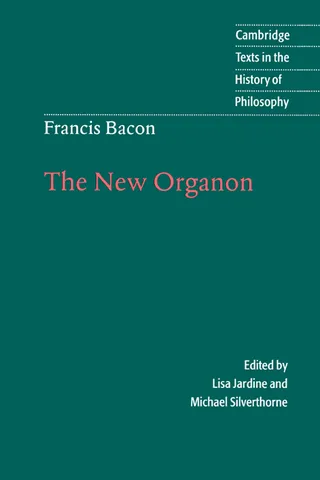
In Novum Organum, Sir Francis Bacon revolutionizes the pursuit of knowledge by introducing the scientific method. This seminal work advocates for empirical observation and inductive reasoning, challenging traditional Aristotelian thought. Bacon's visionary approach lays the foundation for modern science, urging humanity to seek truth through experimentation and
critical inquiry.
Francis Bacon
Francis Bacon (1561-1626) was an English philosopher, statesman, and scientist who is considered one of the most influential thinkers of the early modern period. He was born in London to a prominent family and received a classical education at Trinity College, Cambridge. Bacon's early career was marked by his work as a lawyer and his rise through the ranks of government, eventually becoming Lord Chancellor under King James I. However, he is best known for his contributions to philosophy and science. Bacon is often credited with developing the scientific method, which emphasizes empirical observation and experimentation as the basis for knowledge. His major works include "Novum Organum," which outlines his new method of inquiry, and "The Advancement of Learning," which argues that the pursuit of knowledge is essential for human progress. Despite his many accomplishments, Bacon's career was marred by scandal and controversy, including accusations of corruption during his time as Lord Chancellor. Nevertheless, his ideas and legacy continue to be studied and debated today.
More by Francis Bacon



Why Readwise Books?
Readwise Books is an ebook & audiobook platform that automatically logs how much you and your friends read, making it fun and easy to read more. Learn more →