Report an issue
Tell us what's wrong and we'll take a look.
Thanks – we got it. We'll review and follow up if needed.
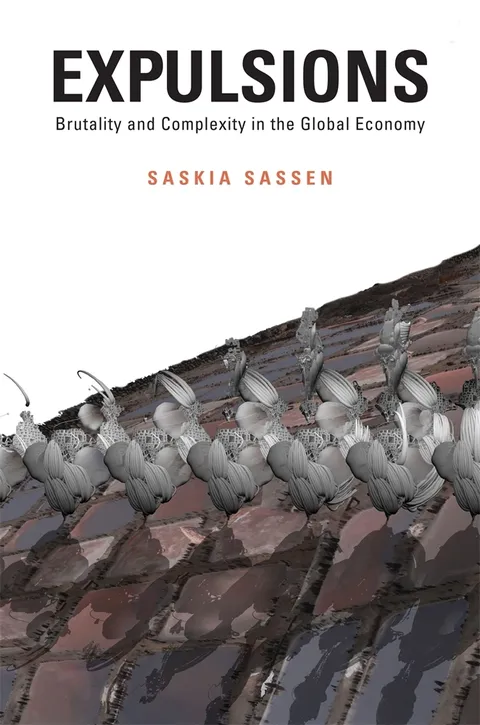
Soaring income inequality and unemployment, expanding populations of the displaced and imprisoned, accelerating destruction of land and water bodies: today's socioeconomic and environmental dislocations cannot be fully understood in the usual terms of poverty and injustice, according to Saskia Sassen. They are more accurately understood as a type of expulsion--from professional livelihood, from living space, even from the very biosphere that makes life possible.
This hard-headed critique updates our understanding of economics for the twenty-first century, exposing a system with devastating consequences even for those who think they are not vulnerable. From finance to mining, the complex types of knowledge and technology we have come to admire are used too often in ways that produce elementary brutalities. These have evolved into predatory formations--assemblages of knowledge, interests, and outcomes that go beyond a firm's or an individual's or a government's project.
Sassen draws surprising connections to illuminate the systemic logic of these expulsions. The sophisticated knowledge that created today's financial "instruments" is paralleled by the engineering expertise that enables exploitation of the environment, and by the legal expertise that allows the world's have-nations to acquire vast stretches of territory from the have-nots. Expulsions lays bare the extent to which the sheer complexity of the global economy makes it hard to trace lines of responsibility for the displacements, evictions, and eradications it produces--and equally hard for those who benefit from the system to feel responsible for its depredations.
Saskia Sassen
Saskia Sassen is the Robert S. Lynd Professor of Sociology and co-chair of The Committee on Global Thought at Columbia University (www.saskiasassen.com). She is the author of Territory, Authority, Rights: From Medieval to Global Assemblages (2008), A Sociology of Globalization (2007), and The Global City (1991), and editor of Deciphering the Global: Its Spaces, Scales and Subjects (2007). Her books have been translated into 22 languages. She is the editor of the volume on urban sustainability in the new 14-volume Encyclopedia of Life Support Systems (2006), for which she coordinated a network of researchers and activists in 30 countries.
More by Saskia Sassen


Why Readwise Books?
Readwise Books is an ebook & audiobook platform that automatically logs how much you and your friends read, making it fun and easy to read more. Learn more →