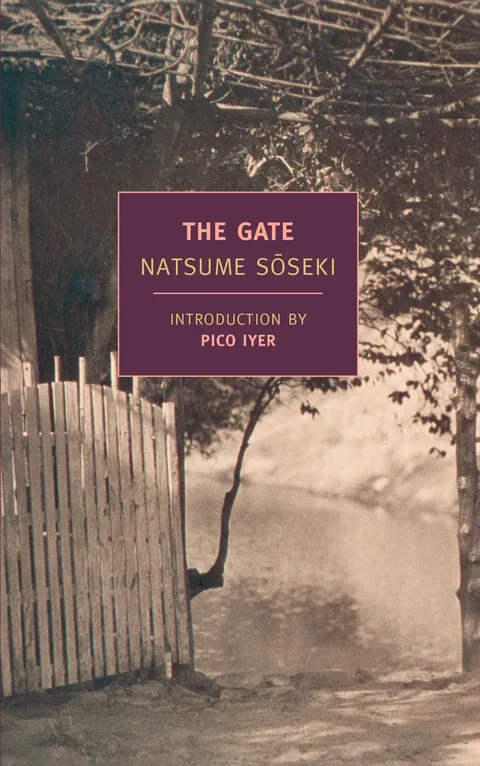
The Gate
Report an issue
Tell us what's wrong and we'll take a look.
Thanks – we got it. We'll review and follow up if needed.
An NYRB Classics Original
A humble clerk and his loving wife scrape out a quiet existence on the margins of Tokyo. Resigned, following years of exile and misfortune, to the bitter consequences of having married without their families’ consent, and unable to have children of their own, Sōsuke and Oyone find the delicate equilibrium of their household upset by a new obligation to meet the educational expenses of Sōsuke’s brash younger brother. While an unlikely new friendship appears to offer a way out of this bind, it also soon threatens to dredge up a past that could once again force them to flee the capital. Desperate and torn, Sōsuke finally resolves to travel to a remote Zen mountain monastery to see if perhaps there, through meditation, he can find a way out of his predicament.
This moving and deceptively simple story, a melancholy tale shot through with glimmers of joy, beauty, and gentle wit, is an understated masterpiece by one of Japan’s greatest writers. At the end of his life, Natsume Sōseki declared The Gate, originally published in 1910, to be his favorite among all his novels. This new translation captures the oblique grace of the original while correcting numerous errors and omissions that marred the first English version.
Natsume Soseki
Nastume Soseki (1867-1916) was born the youngest of eight children during the last year of the Tokugawa shogunate in Edo, the city shortly to be renamed Tokyo, and became the defining writer of the Meiji period (1868-1912). Raised by foster parents until he was nine, he made a faltering start at school but soon displayed a special aptitude for Chinese studies and later for the English language, ultimately earning an advanced degree in English literature. As an undergraduate at Tokyo Imperial University, he published an essay on Walt Whitman that introduced the poet's work to Japan. After teaching for several years, Soseki was sent in 1900 to England for two years by the Ministry of Education. Upon his return he succeeded Lafcadio Hearn in the English department at Tokyo Imperial University. Soseki published his first work of fiction in 1905, the opening chapter of what would become the famous satirical novel I Am a Cat. In 1907, offered a position with the Asahi Newspaper publishing company, he left teaching to become a full-time writer, and proceeded to produce novels at the rate of one a year until his death from a stomach ulcer in 1916. Other major works to have appeared in English translation include Botchan, Kusamakura, The Miner, and Kokoro.
More by Natsume Soseki


William F Sibley
Translated by
William F. Sibley (1941-2009) was a professor of East Asian languages and civilizations at the University of Chicago. A translator of Japanese fiction and nonfiction, Sibley was at work on Soseki's First Trilogy, comprising Sanshiro, And Then, and The Gate, at the time of his death.






Why Readwise Books?
Readwise Books is an ebook & audiobook platform that automatically logs how much you and your friends read, making it fun and easy to read more. Learn more →