Report an issue
Tell us what's wrong and we'll take a look.
Thanks – we got it. We'll review and follow up if needed.
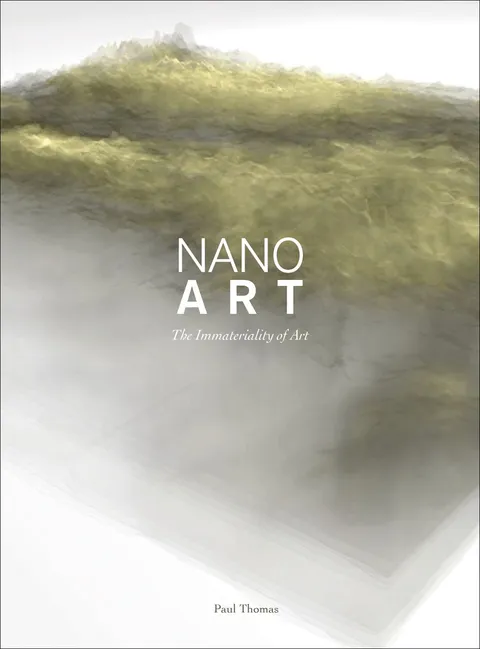
Nano is Greek for dwarf and the word nanotechnology ‘was first proposed in the early seventies by a Japanese engineer, Norio Taniguchi, implying a new technology that went beyond controlling materials and engineering on the micrometer scale that dominated the 20th Century’. The content for this book has been based on a self-emergent process. It explores an art historical understanding of matter and uses various hypotheses to elucidate the effects on materiality and agency as a result of the emergence of nanotechnology. The blurring of material boundaries are reflected in the establishment of a fluid organic spatial narrative in which to place ideas, propositions and concerns. A cornerstone of the book is the concept posed in the philosophical writings of Lucretius of the unpredictability of the atoms’ swerve and its formative role in the beginning of all matter, form, life and individuality. It focusses on the concepts of vibration, vitalism, life and materiality and extends the artist’s concepts of agency in relation to matter.
Paul Thomas
Paul Thomas is honorary professor at the University of New South Wales (UNSW); he is the founder and series-chair of the Transdisciplinary Imaging Conference series 2010–22. Thomas’s current artworks ‘Quantum Chaos’ are based on experiments with the Quantum Computation Centre, UNSW. He has written on quantum art and nanotechnologies.
Contact: University of New South Wales, School of Art & Design, Cnr. Oxford St. & Greens Rd., Paddington NSW 2021, Australia.
Wed address: http://Visiblespace.com


Why Readwise Books?
Readwise Books is an ebook & audiobook platform that automatically logs how much you and your friends read, making it fun and easy to read more. Learn more →