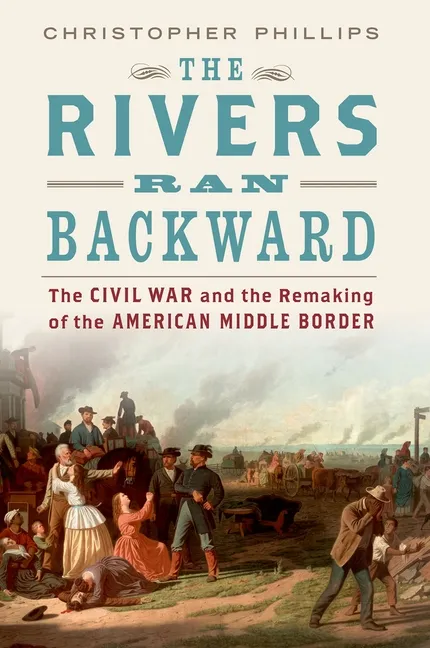
The Rivers Ran Backward
The Civil War and the Remaking of the American Middle Border
Report an issue
Tell us what's wrong and we'll take a look.
Thanks – we got it. We'll review and follow up if needed.
In The Rivers Ran Backward, Christopher Phillips sheds light on the fluid political cultures of the "Middle Border" states during the Civil War era. Far from forming a fixed and static boundary between the North and South, the border states experienced fierce internal conflicts over their political and social loyalties. White supremacy and widespread support for the existence of slavery pervaded the "free" states of Ohio, Indiana, and Illinois, which had much closer economic and cultural ties to the South, while those in Kentucky and Missouri held little identification with the South except over slavery. Debates raged at every level, from the individual to the state, in parlors, churches, schools, and public meeting places, among families, neighbors, and friends. Ultimately, the pervasive violence of the Civil War and the cultural politics that raged in its aftermath proved to be the strongest determining factor in shaping these states' regional identities, leaving an indelible imprint on the way in which Americans think of themselves and others in the nation.
The Rivers Ran Backward reveals the complex history of the western border states as they struggled with questions of nationalism, racial politics, secession, neutrality, loyalty, and even place-as the Civil War tore the nation, and themselves, apart. In this major work, Phillips shows that the Civil War was more than a conflict pitting the North against the South, but one within the West that permanently reshaped American regions.





Why Readwise Books?
Readwise Books is an ebook & audiobook platform that automatically logs how much you and your friends read, making it fun and easy to read more. Learn more →