Report an issue
Tell us what's wrong and we'll take a look.
Thanks – we got it. We'll review and follow up if needed.
Opening address, Stuttgart, August 20, 1919
14 lectures, Stuttgart, August 21-September 5, 1919 (CW 293)
2 lectures, Berlin, March 15 and 17, 1917 (CW 66)
--Rudolf Steiner
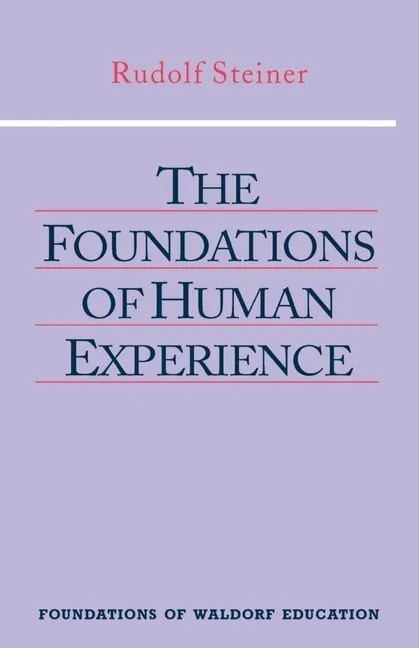
This course on education contains some of the most remarkable and significant lectures ever given by Rudolf Steiner. Because these lectures were given to teachers, however, they have suffered the misconception that they are useful only to teachers. Any teacher who wants to teach in a way that encompasses the whole child certainly needs a functional understanding of what Steiner presents here, but these lectures will also greatly benefit parents, psychologists, counselors, or anyone else involved with child development.
Steiner gives his most concise and detailed account of human nature in these lectures, which are absolutely essential for anyone who wants a deeper understanding of Steiner's spiritual science. Those who are willing to work through this work will discover here a new, powerful, convincing, and profoundly phenomenological "anthropology" of human spiritual psychology.
In these lectures, Steiner laid out for the first time the principles that form the basis for renewing the art of teaching. The Foundations of Human Experience is probably the most important text for studying and understanding the human developmental and psychological basis of Waldorf educational principles.
Translated from the German editions: Allgemeine Menschenkunde als Grundlage der Pädagogik (GA 239); appendix from Geist und Stoff. Leben und Tod (GA 66). An earlier translation was titled Study of Man.
Rudolf Steiner
Rudolf Steiner (1861-1925) was born in the small village of Kraljevec, Austro-Hungarian Empire (now in Croatia), where he grew up. As a young man, he lived in Weimar and Berlin, where he became a well-published scientific, literary, and philosophical scholar, known especially for his work with Goethe's scientific writings. At the beginning of the twentieth century, he began to develop his early philosophical principles into an approach to systematic research into psychological and spiritual phenomena. Formally beginning his spiritual teaching career under the auspices of the Theosophical Society, Steiner came to use the term Anthroposophy (and spiritual science) for his philosophy, spiritual research, and findings. The influence of Steiner's multifaceted genius has led to innovative and holistic approaches in medicine, various therapies, philosophy, religious renewal, Waldorf education, education for special needs, threefold economics, biodynamic agriculture, Goethean science, architecture, and the arts of drama, speech, and eurythmy. In 1924, Rudolf Steiner founded the General Anthroposophical Society, which today has branches throughout the world. He died in Dornach, Switzerland.
More by Rudolf Steiner



Robert F Lathe
Translated by
Robert F. Lathe has translated several books by Rudolf Steiner on Anthroposophy and Waldorf education


Why Readwise Books?
Readwise Books is an ebook & audiobook platform that automatically logs how much you and your friends read, making it fun and easy to read more. Learn more →