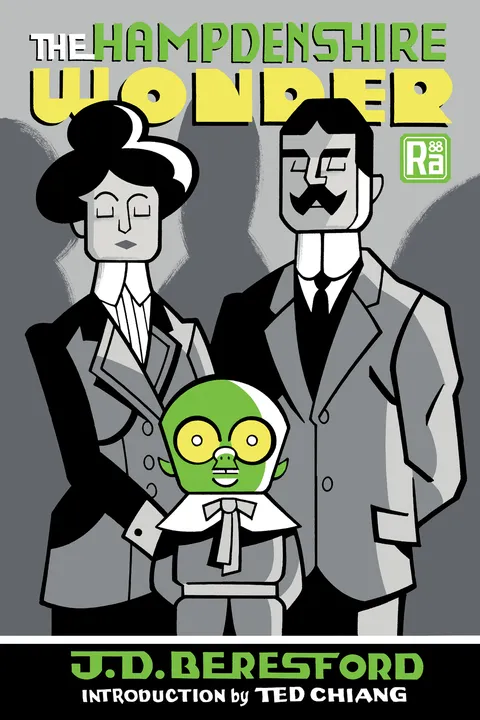
The Hampdenshire Wonder
Report an issue
Tell us what's wrong and we'll take a look.
Thanks – we got it. We'll review and follow up if needed.
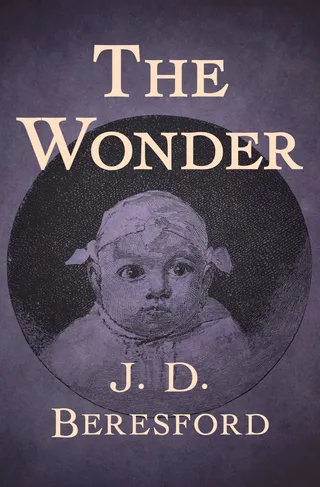
In this pioneering science-fictional treatment of superhuman intelligence, a mutant wonder child’s insights prove devastating.
Science fiction luminary Ted Chiang introduces The Hampdenshire Wonder, one of the genre’s first treatments of superhuman intelligence. Victor Stott is a large-headed “supernormal” mutated in the womb by his parents’ desire to have a child born without habits. Known as “the Wonder,” Victor surveys humankind’s science, philosophy, history, literature, religion—the best that has been thought and said—and dismisses it brutally: “So elementary . . . inchoate . . . a disjunctive patchwork.” Rejecting “the interposing and utterly false concepts of space and time,” the Wonder claims that life itself is merely “a disease of the ether.” Unable to deal with the child’s disenchanting insights, his adult interlocutors seek to silence him . . . perhaps permanently.
J. D. Beresford
J. D. Beresford (1873−1947) was an English author and book critic. The son of a clergyman, he was crippled by polio, an experience that profoundly influenced his work. He is best remembered today for his early science fiction novels, including The Wonder and The Riddle of the Tower.
More by J. D. Beresford




Why Readwise Books?
Readwise Books is an ebook & audiobook platform that automatically logs how much you and your friends read, making it fun and easy to read more. Learn more →