
Report an issue
Tell us what's wrong and we'll take a look.
Thanks – we got it. We'll review and follow up if needed.
In these poems speaks the struggling soul of a downtrodden people. To our western folk, reared in happier surroundings there is a bitter tang about some of them, somewhat like the taste of olives, to which one must grow accustomed . The Slavonic temperament, too, is given to melancholy and seems to dwell congenially in an atmosphere misty with tears. But he gravely misreads their literature who fails to perceive the grim resolve beneath the sorrow. In the struggle of the Ukrainians for freedom the spirit of this poet, who was born a serf, remains ever their guiding star. The translator of these poems spent considerable time in arriving at an understanding of the spirit of the poems and the nature of the situations described. Then the more formidable task was approached of trying to carry over not only the thought but something of the style, spirit and music of the original into the English tongue.
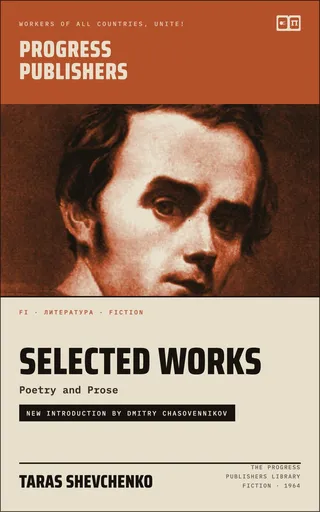
Taras Shevchenko
Taras Shevchenko was born a serf in 1814 and was twenty-four before he was a free man. His freedom was bought in 1838 with the money raised by a lottery for a portrait painted by Karl Bryullov, and he went into the Academy of Arts in Petersburg as a student of painting. Two years after he was freed he published Kobzar, his first book of poems.In 1845 he was back in Ukraine, travelling for the Archaeographic Commission and describing old churches and monuments in the Poltava country - Lubny, Bahachka, Pereiaslav, Andrushi. Those are the roads his characters walk in this book. On 5 April 1847 he was arrested at the Dnipro crossing by Kyiv as a member of the Cyril and Methodius Brotherhood, and was sent to the Separate Orenburg Corps as a private soldier, under an order that he was not to write and not to draw.He served at the Orsk fortress, crossed the steppe with the Aral survey expedition, and from October 1850 was held at the Novopetrovsk fort on the Caspian, where he remained nearly seven years. He wrote nine novellas in Russian in the years of his exile. This is one of them, written there in the summer of 1855, and it was not printed in his lifetime.The 2003 editors of his collected works call the problem of upbringing the main subject of the book, and note that it is the first of his works to take up the educational ideas of the philosopher Grigory Skovoroda - who is also one of its characters. They point out, too, how much of the author's own life is in it: the Pereiaslav country he had described for the Commission, his time in Kyiv, and his first years of exile, at Orenburg and on the road to the Orsk fortress.He was released in 1857 and died at Petersburg in 1861, aged forty-seven. He was buried, as he had asked, on a hill near Kaniv, and The Twins first appeared in print twenty-five years later.
More by Taras Shevchenko



Why Readwise Books?
Readwise Books is an ebook & audiobook platform that automatically logs how much you and your friends read, making it fun and easy to read more. Learn more →