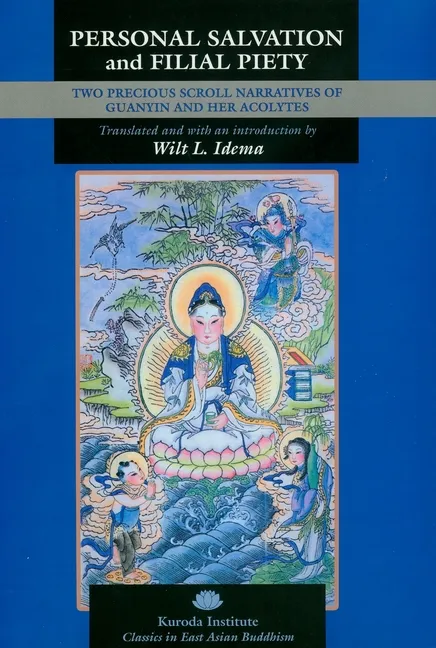
Personal Salvation and Filial Piety
Two Precious Scroll Narratives of Guanyin and Her Acolytes
Report an issue
Tell us what's wrong and we'll take a look.
Thanks – we got it. We'll review and follow up if needed.
The Bodhisattva Avalokitesvara was a handsome prince when he entered China. As Guanyin, the bodhisattva was venerated from the eleventh century onward in the shape of a beautiful woman who became a universal savior. Throughout the last millennium, the female Guanyin has enjoyed wide and fervid veneration throughout East Asia and has appeared as a major character in literature and legend. In one tale, Guanyin (as the princess Miaoshan) returns from the dead after being executed by the king, her father, for refusing to marry. The most popular version of this legend is The Precious Scroll of Incense Mountain (Xiangshan baojuan), a long narrative in prose and verse and a work of considerable literary merit. It emphasizes the conflict between father and daughter, in the course of which all conventional arguments against a religious lifestyle are paraded and rebutted. A lengthy description of Guanyin's visit to the underworld, which focuses on the conflict between grace and justice, is also included.
Personal Salvation and Filial Piety offers a complete and fully annotated translation of The Precious Scroll, based on a nineteenth-century edition. The translation is preceded by a substantial introduction that discusses the origin of the text and the genre to which it belongs and highlights the similarities and differences between the scroll and female saints' lives from medieval Europe. There follows a translation of the much-shorter Precious Scroll of Good-in-Talent and Dragon Daughter, which provides a humorous account of how Guanyin acquired the three acolytes--Sudhana, Nagakanya, and a white parrot--who are often shown surrounding her in popular prints.
As the first English-language translation of major "precious scrolls," Personal Salvation and Filial Piety will appeal to a wide range of readers--from scholars of Chinese literature to students of Buddhism. Beyond the field of East Asian studies, it will interest specialists in comparative religion and literature and feminist theologians. Because of its lively and moving narratives, the text is suitable for courses on popular Buddhist religiosity (particularly female religiosity) in Chinese society.
Wilt L Idema
Translated by
Wilt L. Idema is Professor Emeritus of Chinese Literature at Harvard University and a recipient of the prestigious Special Book Award of China. Dr. Idema's many publications include "The Immortal Maiden Equal to Heaven" and Other Precious Scrolls from Western Gansu, The Legend of Prince Golden Calf in China and Korea, Insects in Chinese Literature: A Study and Anthology, and Divine Interventions: Gods, Exorcisms, and Supernatural Power in Early Chinese Theater.


Why Readwise Books?
Readwise Books is an ebook & audiobook platform that automatically logs how much you and your friends read, making it fun and easy to read more. Learn more →