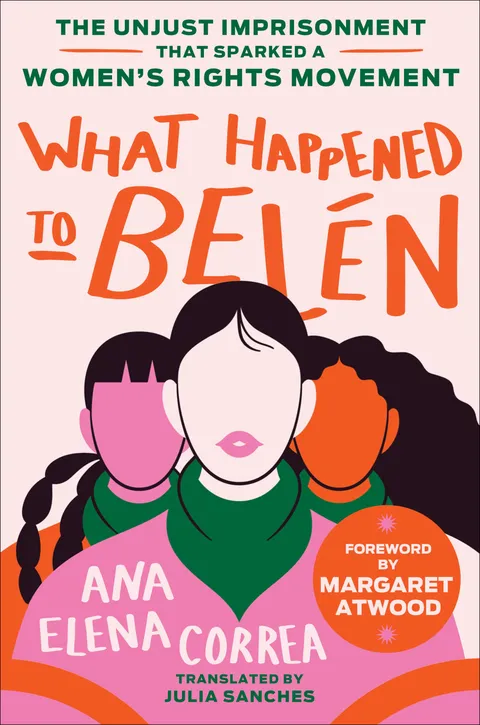
What Happened to Belén
The Unjust Imprisonment That Sparked a Women’s Rights Movement
Report an issue
Tell us what's wrong and we'll take a look.
Thanks – we got it. We'll review and follow up if needed.
"There are many women like Belén whose names we don’t know, but whose stories are just as important. An uplifting chronicle of one woman’s fight for justice."—Kirkus Reviews (starred review)
Foreword by Margaret Atwood
The heartbreaking true story of an Argentinian woman wrongfully imprisoned for having a miscarriage—an injustice that galvanized a powerful feminist movement and became a global rallying cry in the fight for reproductive rights.
In 2014, Belén, a twenty-five-year-old woman living in rural Argentina, went to the hospital for a stomachache—and soon found herself in prison. While at the hospital she had a miscarriage—without knowing she was pregnant. Because of the nation’s repressive laws surrounding abortion and reproductive rights, the doctors were forced to report her to the authorities. Despite her protestations, Belén was convicted and sentenced to two years for homicide.
This landmark case is a glaring example of how women’s health care has become increasingly criminalized, putting the most vulnerable—BIPOC, rural, and low-income—women at greater risk of prosecution. Belén’s cause became the centerpiece of a movement to achieve greater protections for all women. After two failed attempts to clear her name, Belén met feminist lawyer Soledad Deza, who quickly rallied Amnesty International and ignited an international feminist movement around #niunamas—not one more—symbolized by thousands of demonstrators around the globe donning white masks, the same kind of mask Belén wore when leaving prison. The #niunamas movement was instrumental in pressuring Argentine president Alberto Fernández to decriminalize abortion in 2021.
Translated by Julia Sanches
In this gripping and personal account of the legal battle and its impact on local law, Ana Correa, one of Argentina’s leading journalists and activists, makes clear that what happened to Belén could happen to any woman—and that we all have the power to raise our collective voices and demand change.
What Happened to Belén is more than a true story; it’s a journalistic investigation into a fight for human rights that reveals:
- A Landmark Case for Reproductive Rights: The unbelievable story of how a young woman went to the emergency room for a stomachache and was sentenced for homicide after having a miscarriage she didn't know about.
- The Fight for Justice: Inside the grueling legal battle led by feminist lawyer Soledad Deza to clear Belén’s name against a repressive legal system.
- A Global Feminist Movement: How Belén's cause, championed by Amnesty International, sparked the international #niunamas movement and brought thousands into the streets demanding change.
- The Power of Collective Action: A powerful testament to how grassroots activism and investigative journalism can challenge systemic injustice and ultimately pressure a government to change its laws.
Ana Elena Correa
Ana Elena Correa is a lawyer, journalist, and women’s rights activist based in Buenos Aires, Argentina. She hosts the literature podcast Nota al pie and was one of the organizers behind the Ni Una Menos women’s rights campaign in 2015. What Happened to Belén is her first book.
Julia Sanches
Translated by
Julia Sanches is a literary translator working from Portuguese, Spanish, and Catalan. Recent translations include Undiscovered by Gabriela Wiener, shortlisted for the International Booker Prize in 2024, Boulder by Eva Baltasar, shortlisted for the International Booker Prize in 2023, and Migratory Birds by Mariana Oliver, for which she won the 2022 PEN translation prize. Born in Brazil, she currently lives in Providence, Rhode Island.


Why Readwise Books?
Readwise Books is an ebook & audiobook platform that automatically logs how much you and your friends read, making it fun and easy to read more. Learn more →