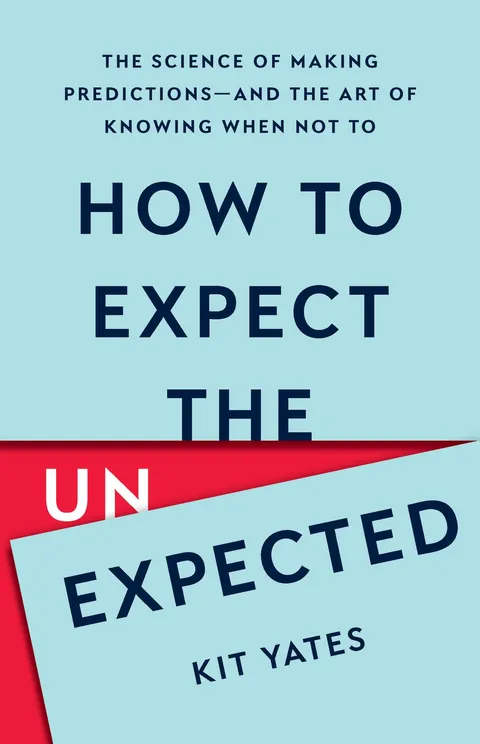
How to Expect the Unexpected
The Science of Making Predictions—and the Art of Knowing When Not To
Report an issue
Tell us what's wrong and we'll take a look.
Thanks – we got it. We'll review and follow up if needed.
A “vivid, wide-ranging, and delightful guide” (bestselling author Tim Harford) for understanding how and why predictions go wrong, with practical tips to give you a better chance of getting them right
How can you be 100 percent sure you will win a bet? Why did so many Pompeians stay put while Mount Vesuvius was erupting? Are you more likely to work in a kitchen if your last name is Baker? Ever since the dawn of human civilization, we have been trying to make predictions about what the world has in store for us. For just as long, we have been getting it wrong. In How to Expect the Unexpected, mathematician Kit Yates uncovers the surprising science that undergirds our predictions—and how we can use it to our advantage.
From religious oracles to weather forecasters, and from politicians to economists, we are subjected to poor predictions all the time. Synthesizing results from math, biology, psychology, sociology, medicine, economic theory, and physics, Yates provides tools for readers to understand uncertainty and to recognize the cognitive biases that make accurate predictions so hard to come by.
This book will teach you how and why predictions go wrong, help you to spot phony forecasts, and give you a better chance of getting your own predictions correct.
Kit Yates
Kit Yates is Professor of Mathematical Biology and Public Engagement at the University of Bath. He completed his PhD in mathematics at the University of Oxford in 2011. He is the author of The Maths of Life and Death, which was a Sunday Times Science Book of the Year, and How to Expect the Unexpected. You Don't Know What You're Missing is his third book.
More by Kit Yates









Why Readwise Books?
Readwise Books is an ebook & audiobook platform that automatically logs how much you and your friends read, making it fun and easy to read more. Learn more →