Report an issue
Tell us what's wrong and we'll take a look.
Thanks – we got it. We'll review and follow up if needed.
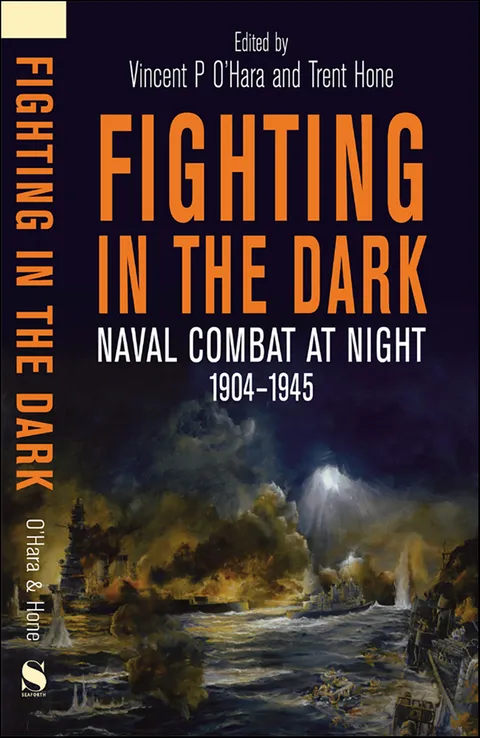
Fighting in the Dark is a new book about naval combat at night; the title also, however, signifies the overarching theme of the book, of moving from dark to light: in short, the process of mastering technological change during war. The authors start with the proposition that it is hard to hit an invisible target, particularly one in motion. In the nineteenth century, when ships relied upon visual signaling and vessels beyond hailing range were deaf and mute in the dark, night battles at sea were rare and largely accidental. Three inventions changed this: the torpedo, the searchlight, and the radio. These inventions at the end of the nineteenth and start of the twentieth centuries transformed naval warfare by making combat in the dark feasible and in some cases, desirable. The process by which navies used the dark and adapted it into a medium for effective combat was long and difficult, more so for some than others. This book is about that process and about how Russian, British, German, Italian, Japanese and US navies confronted the specific new challenges and adapted to unfamiliar situations and emerging technologies. Fighting in the Dark consists of chapters written by a group of highly respected naval historians, and the book's approach illuminates how different navies and cultures approached common problems. The fierce night-time battles that are described serve as a metaphor for the larger issues and the reader is led along a fascinating journey of naval warfare from the Russo-Japanese War, through WWI, to the Second World War, and from the Pacific to the English Channel.
Vincent P. O'Hara
Vincent P. O'Hara is a naval historian and the author, coauthor, or editor of seventeen books, including Struggle for the Middle Sea and Fighting in the Dark. He was the Naval Institute Author of the Year in 2016 for Torch. His work has also appeared in many magazines and journals and has been translated into Spanish, Japanese, and Italian. He holds a history degree from the University of California, Berkeley and lives in Chula Vista, California.
Trent Hone
Trent Hone is an authority on the U.S. Navy of the early twentieth century and a leader in the application of complexity science to organizational design. He studied religion and archaeology at Carleton College in Northfield, MN and works as a consultant helping a variety of organizations improve their processes and techniques. Mr. Hone regularly writes and speaks about leadership, sensemaking, organizational learning, and complexity. His talents are uniquely suited to integrate the history of the Navy with modern management theories, generating new insights relevant to both disciplines.


Why Readwise Books?
Readwise Books is an ebook & audiobook platform that automatically logs how much you and your friends read, making it fun and easy to read more. Learn more →