Report an issue
Tell us what's wrong and we'll take a look.
Thanks – we got it. We'll review and follow up if needed.
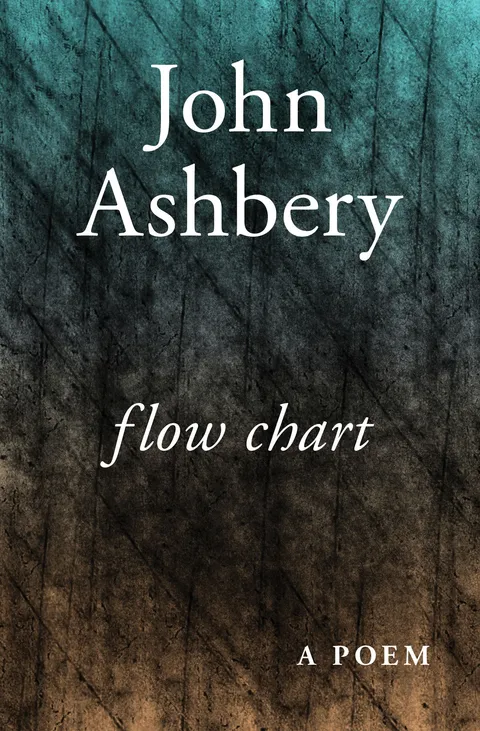
A quintessentially American epic poem that rewrites all the rules of epic poetry—starting with the one that says epic poetry can't be about the writing of epic poetry itself The appearance of Flow Chart in 1991 marked the kickoff of a remarkably prolific period in John Ashbery's long career, a decade during which he published seven all-new books of poetry as well as a collected series of lectures on poetic form and practice. So it comes as no surprise that this book-length poem—one of the longest ever written by an American poet—reads like a rocket launch: charged, propulsive, mesmerizing, a series of careful explosions that, together, create a radical forward motion. It's been said that Flow Chart was written in response to a dare of sorts: Artist and friend Trevor Winkfield suggested that Ashbery write a poem of exactly one hundred pages, a challenge that Ashbery took up with plans to complete the poem in one hundred days. But the celebrated work that ultimately emerged from its squared-off origin story was one that the poet himself called "a continuum, a diary." In six connected, constantly surprising movements of free verse—with the famous "sunflower" double sestina thrown in, just to reinforce the poem's own multivarious logic—Ashbery's poem maps a path through modern American consciousness with all its attendant noise, clamor, and signal: "Words, however, are not the culprit. They are at worst a placebo, / leading nowhere (though nowhere, it must be added, can sometimes be a cozy / place, preferable in many cases to somewhere)."
John Ashbery
John Ashbery's latest book of poems is Quick Question. From 1960 to 1965, he was the International Herald Tribune art critic and ArtNews Paris correspondent. France has named him Chevalier des Arts et des Lettres and Officier of the Légion d'Honneur. He has received a National Book Foundation Medal for Distinguished Contribution to American Letters, and President Obama awarded him a National Humanities Medal. Rosanne Wasserman and Eugene Richie's latest poetry book is Psyche and Amor. They have edited Ashbery's essays in Other Traditions and in Selected Prose, as well as his translations of Pierre Martory. She teaches at the U.S. Merchant Marine Academy; he is the director of writing at Pace University.
More by John Ashbery


Why Readwise Books?
Readwise Books is an ebook & audiobook platform that automatically logs how much you and your friends read, making it fun and easy to read more. Learn more →