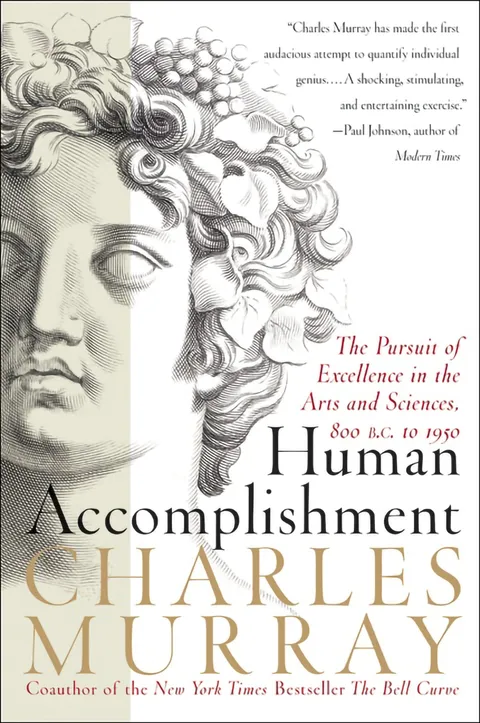
Human Accomplishment
The Pursuit of Excellence in the Arts and Sciences, 800 B.C. to 1950
Report an issue
Tell us what's wrong and we'll take a look.
Thanks – we got it. We'll review and follow up if needed.
"Readers . . . are sure to enjoy [the] arguments and elegant presentation" of this "engaging" cultural survey by the controversial co-author of The Bell Curve (Kirkus Reviews). "At irregular times and in scattered settings, human beings have achieved great things. Human Accomplishment is about those great things, falling in the domains known as the arts and sciences, and the people who did them.' So begins Charles Murray's unique account of human excellence, from the age of Homer to our own time. Murray compiles inventories of the people who have been essential to the stories of literature, music, art, philosophy, and the sciences—a total of 4,002 men and women from around the world, ranked according to their eminence. The heart of Human Accomplishment is a series of enthralling descriptive chapters: on the giants in the arts and what sets them apart from the merely great. Charles Murray takes on some controversial questions. Why has accomplishment been so concentrated in Europe? Among men? Since 1400? He presents evidence that the rate of great accomplishment has been declining in the last century, asks what it means, and offers a rich framework for thinking about the conditions under which the human spirit has expressed itself most gloriously. "Well-written and informative." —Publishers Weekly
Charles Murray
Catherine Bly Cox and Charles Murray were born and raised in Newton, Iowa, six years and three blocks apart. She was educated at William and Mary, Oxford, and Yale and was a professor of English literature when she and Murray re-met in their thirties and married.
He was educated at Harvard and the Massachusetts Institute of Technology and has made his career as a writer about public policy. Since 1990, he has been a fellow at the American Enterprise Institute. Among his other books are Losing Ground, The Bell Curve (with Richard J. Herrnstein), and Human Accomplishment.
Cox and Murray already shared a long-standing fascination with the exploration of space when they took Jack Trombka's astrophysics course in 1983 and decided to write a book about the people on the ground. They moved to Burkittsville, Maryland, shortly after Apollo was first published in 1989, and have lived there happily ever after.
More by Charles Murray



Why Readwise Books?
Readwise Books is an ebook & audiobook platform that automatically logs how much you and your friends read, making it fun and easy to read more. Learn more →