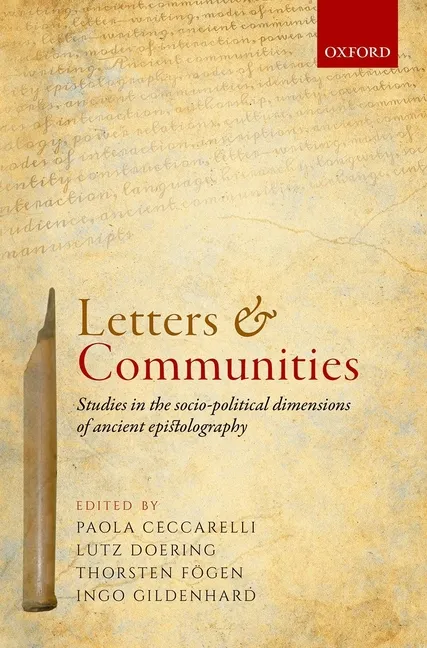
Letters and Communities
Studies in the Socio-Political Dimensions of Ancient Epistolography
Report an issue
Tell us what's wrong and we'll take a look.
Thanks – we got it. We'll review and follow up if needed.
This volume explores the interrelation of letters and communities in the ancient world, examining how epistolary communication aided in the construction and cultivation of group-identities and communities, whether social, political, religious, ethnic, or philosophical. A theoretically informed Introduction establishes the interface of epistolary discourse and group formation as a vital but hitherto neglected area of research, and is followed by thirteen case studies offering multi-disciplinary perspectives from four key cultural configurations: Greece, Rome, Judaism, and Christianity. The first part opens the volume with two chapters on the theory and practice of epistolary communication that focus on ancient epistolary theory and the unavoidable presence of a letter-carrier who introduces a communal aspect into any correspondence, while the second comprises five chapters that explore configurations of power and epistolary communication in the Greek and Roman worlds, from the archaic period to the end of the Hellenistic age. Five chapters on letters and communities in Ancient Judaism and Early Christianity follow in the third, part before the volume concludes with an envoi examining the trans-historical, or indeed timeless, philosophical community Seneca the Younger construes in his Letters to Lucilius.


Why Readwise Books?
Readwise Books is an ebook & audiobook platform that automatically logs how much you and your friends read, making it fun and easy to read more. Learn more →