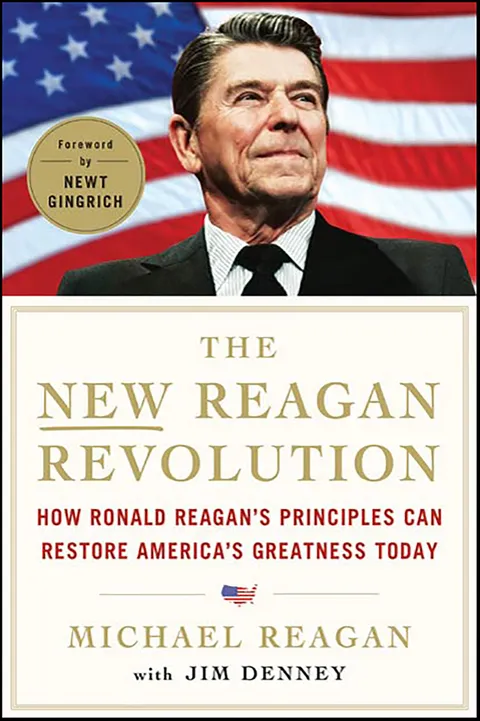
The New Reagan Revolution
How Ronald Reagan's Principles Can Restore America's Greatness
Report an issue
Tell us what's wrong and we'll take a look.
Thanks – we got it. We'll review and follow up if needed.
"There are cynics who say that a party platform is something that no one bothers to read and it doesn't very often amount to much. Whether it is different this time than it has ever been before, I believe the Republican Party has a platform that is a banner of bold, unmistakable colors, with no pastel shades." –Ronald Reagan, 1976 Republican National Convention When Ronald Reagan was called to the podium by President Ford during the 1976 Republican National Convention, he had no prepared remarks. But the unrehearsed speech he gave that night is still regarded as one of the most moving speeches of his political career. The reason he was able to give such a powerful speech on a moment's notice was that he was proclaiming the core principles of his heart and soul, which he had been teaching and preaching for years. The New Reagan Revolution reveals new insights into the life, thoughts, and actions of the man who changed the world during the 1980s. The challenges and threats we face today are eerily similar to the conditions in the world before the beginning of the Reagan era. The good news is that we already know what works. Ronald Reagan has given us the blueprint. This book is not merely a diagnosis of our nation's ills, but a prescription to heal our nation, rooted in the words and principles of Ronald Reagan. In these pages, you'll find a plan for returning America to its former greatness, soundness, and prosperity. It's the plan Ronald Reagan developed over years of study, observation, and reflection. It's a plan he announced to the nation, straight from his heart, one summer evening during America's 200th year. It's the plan he put into action during his eight years in office as the most effective president of the 20th century, and it is the plan we can use today to help return America to its former greatness, soundness, and prosperity.
Jim Denney
James Denney was a Scottish theologian and preacher who lived from 8 February 1856 to 12 June 1917. His theological explanation of the meaning of the atonement within Christian theology-that is, that it is "the most profound of all truths"-is arguably what has made him most famous today. Many claim that he was well-known for supporting the penal substitution theory, but this is an incorrect understanding of his views. That being said, Denney himself objected angrily to this portrayal. Born in Paisley, Scotland on February 5, 1856, The Death of Christ Denney was the son of Cameronian (Reformed Presbyterian) parents. His dad was a Cameronian deacon and joiner. The family joined the Free Church of Scotland in 1876, joining the majority of the Reformed Presbyterian Church of Scotland. From 1874 to 1879, he attended the Highlanders' Academy at Greenock, University of Glasgow, and from 1879 to 1883, he attended Free Church College in Glasgow. While attending Glasgow University, he was awarded the Blackstone Prize and the Moral Philosophy Gold Medal. Edward Caird and Richard Jebb had a big influence on him. He also worked briefly as John Veitch's student assistant.
More by Jim Denney











Why Readwise Books?
Readwise Books is an ebook & audiobook platform that automatically logs how much you and your friends read, making it fun and easy to read more. Learn more →