Report an issue
Tell us what's wrong and we'll take a look.
Thanks – we got it. We'll review and follow up if needed.
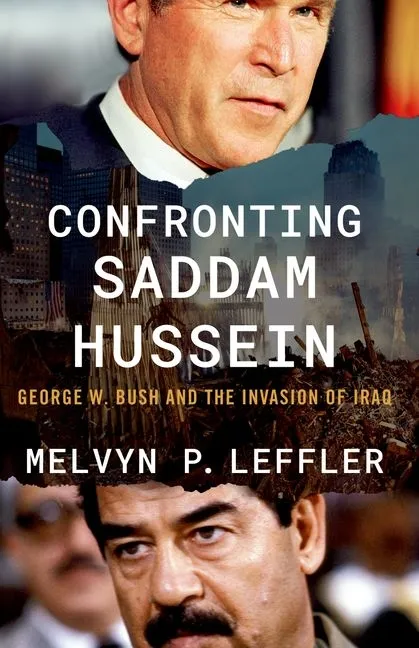
America's decision to go to war in Iraq in 2003 is arguably the most important foreign policy choice of the entire post-Cold War era. Nearly two decades after the event, it remains central to understanding current international politics and US foreign relations.
In Confronting Saddam Hussein, the eminent historian of US foreign policy Melvyn P. Leffler analyzes why the US chose war and who was most responsible for the decision. Employing a unique set of personal interviews with dozens of top officials and declassified American and British documents, Leffler vividly portrays the emotions and anxieties that shaped the thinking of the president after the shocking events of 9/11. He shows how fear, hubris, and power influenced Bush's approach to Saddam Hussein's Iraq. At the core of Leffler's account is his compelling portrait of Saddam Hussein. Rather than stressing Bush's preoccupation with promoting freedom or democracy, Leffler emphasizes Hussein's brutality, opportunism, and unpredictability and illuminates how the Iraqi dictator's record of aggression and intransigence haunted the president and influenced his calculations. Bush was not eager for war, and the decision to invade Iraq was not a fait accompli. Yet the president was convinced that only by practicing coercive diplomacy and threatening force could he alter Hussein's defiance, a view shared by British Prime Minister Tony Blair and other leaders around the world, including Hans Blix, the chief UN inspector. Throughout, Leffler highlights the harrowing anxieties surrounding the decision-making process after the devastating attack on 9/11 and explains the roles of contingency, agency, rationality, and emotion. As the book unfolds, Bush's centrality becomes more and more evident, as does the bureaucratic dysfunctionality that contributed to the disastrous occupation of Iraq.
A compelling reassessment of George W. Bush's intervention in Iraq, Confronting Saddam Hussein provides a provocative reinterpretation of the most important international event of the 21st century.
Melvyn P Leffler
Melvyn P. Leffler is Edward R. Stettinius Professor of American History in the Department of History at the University of Virginia. He is the author of many books, including A Preponderance of Power: National Security, the Truman Administration and the Cold War and For the Soul of Mankind: The United States, the Soviet Union, and the Cold War. Jeffrey W. Legro is Randolph P. Compton Professor in the Department of Politics at the University of Virginia. He is the author of Rethinking the World: Great Power Strategies and International Order and Cooperation under Fire: Anglo-German Restraint during World War II, both from Cornell. Leffler and Legro are also coeditors of To Lead the World: American Strategy after the Bush Doctrine.
More by Melvyn P Leffler


Why Readwise Books?
Readwise Books is an ebook & audiobook platform that automatically logs how much you and your friends read, making it fun and easy to read more. Learn more →