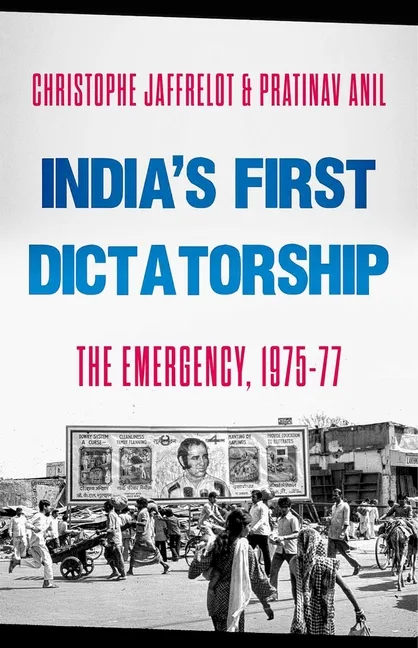
India's First Dictatorship
Report an issue
Tell us what's wrong and we'll take a look.
Thanks – we got it. We'll review and follow up if needed.
India's First Dictatorship focuses on Mrs Gandhi and her son, Sanjay, who was largely responsible for the mass sterilisation programmes and deportation of urban slum-dwellers. However, it equally exposes the facilitation of authoritarian rule by Congressmen, Communists, trade unions, businessmen and the urban middle class, as well as the complacency of the judiciary and media. While opposition leaders eventually closed ranks in jail, many of them collaborated with the new regime--including the RSS. Those who resisted the Emergency, in the media or on the streets, were few in number.
This episode was an acid test for India's political culture. While a tiny minority of citizens fought for democracy during the Emergency, in large numbers the people bowed to a strong woman, even worshipped her. Equally importantly, Hindu nationalists were endowed with a new legitimacy. The Emergency was not a parenthesis, but a turning point; its legacy is very much alive today.

Pratinav Anil
Pratinav Anil is a Lecturer in History at St Edmund Hall, University of Oxford, whose writings have appeared in The Times, The Guardian, Spectator, and History Today. He is the co-author, with Christophe Jaffrelot, of India's First Dictatorship, also published by Hurst.
More by Pratinav Anil














Why Readwise Books?
Readwise Books is an ebook & audiobook platform that automatically logs how much you and your friends read, making it fun and easy to read more. Learn more →