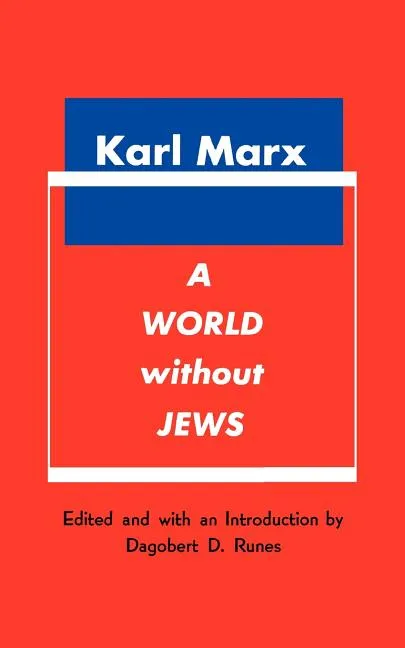
A World Without Jews
Report an issue
Tell us what's wrong and we'll take a look.
Thanks – we got it. We'll review and follow up if needed.

A World Without Jews by Karl Marx speaks about religious prejudice specifically against Jews. It begs to question can the world survive without this prejudice and how Jews beg for political emancipation? Karl Marx (1818-1883) is best known not as a philosopher but as a revolutionary communist, whose works inspired the foundation of many communist regimes in the twentieth century. It is hard to think of many who have had as much influence in the creation of the modern world. Trained as a philosopher, Marx turned away from philosophy in his mid-twenties, towards economics and politics. However, in addition to his overtly philosophical early work, his later writings have many points of contact with contemporary philosophical debates, especially in the philosophy of history and the social sciences, and in moral and political philosophy. Historical materialism -- Marx's theory of history -- is centered around the idea that forms of society rise and fall as they further and then impede the development of human productive power. Marx sees the historical process as proceeding through a necessary series of modes of production, culminating in communism. Marx's economic analysis of capitalism is based on his version of the labour theory of value, and includes the analysis of capitalist profit as the extraction of surplus value from the exploited proletariat. The analysis of history and economics come together in Marx's prediction of the inevitable economic breakdown of capitalism, to be replaced by communism. However Marx refused to speculate in detail about the nature of communism, arguing that it would arise through historical processes, and was not the realisation of a pre-determined moral ideal.
Karl Marx
Karl Marx was born in 1818, in the Rhenish city of Trier, the son of a successful lawyer. He studied law and philosophy at the universities of Bonn and Berlin, completing his doctorate in 1841. In Paris three years later, Marx was introduced to the study of political economy by a former fellow student, Frederick Engels. In 1848 they collaborated in writing The Communist Manifesto. Expelled from Prussia in the same year, Marx took up residence first in Paris and then in London where, in 1867 he published his magnum opus Capital. A co-founder of the International Workingmen's Association in 1864, Marx died in London in 1883.
More by Karl Marx



Why Readwise Books?
Readwise Books is an ebook & audiobook platform that automatically logs how much you and your friends read, making it fun and easy to read more. Learn more →