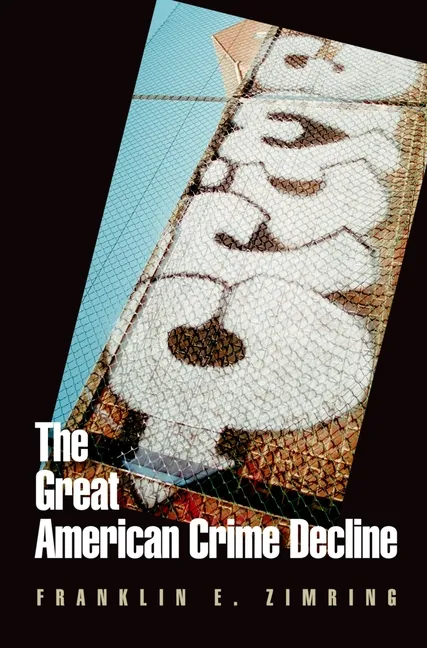
The Great American Crime Decline
Report an issue
Tell us what's wrong and we'll take a look.
Thanks – we got it. We'll review and follow up if needed.
Offering the most reliable data available, Zimring documents the decline as the longest and largest since World War II. It ranges across both violent and non-violent offenses, all regions, and every demographic. All Americans, whether they live in cities or suburbs, whether rich or poor, are safer today. Casting a critical and unerring eye on current explanations, this book demonstrates that both long-standing theories of crime prevention and recently generated theories fall far short of explaining the 1990s drop. A careful study of Canadian crime trends reveals that imprisonment and economic factors may not have played the role in the U.S. crime drop that many have suggested.
There was no magic bullet but instead a combination of factors working in concert rather than a single cause that produced the decline. Further--and happily for future progress, it is clear that declines in the crime rate do not require fundamental social or structural changes. Smaller shifts in policy can make large differences.
The significant reductions in crime rates, especially in New York, where crime dropped twice the national average, suggests that there is room for other cities to repeat this astounding success. In this definitive look at the great American crime decline, Franklin E. Zimring finds no pat answers but evidence that even lower crime rates might be in store.
Franklin E Zimring
Franklin E. Zimring is William G. Simon Professor of Law at the University of California, Berkeley Law School. He is the author of several books, including The City That Became Safe: New York's Lessons for Urban Crime and Its Control and American Juvenile Justice.
More by Franklin E Zimring














Why Readwise Books?
Readwise Books is an ebook & audiobook platform that automatically logs how much you and your friends read, making it fun and easy to read more. Learn more →