Report an issue
Tell us what's wrong and we'll take a look.
Thanks – we got it. We'll review and follow up if needed.
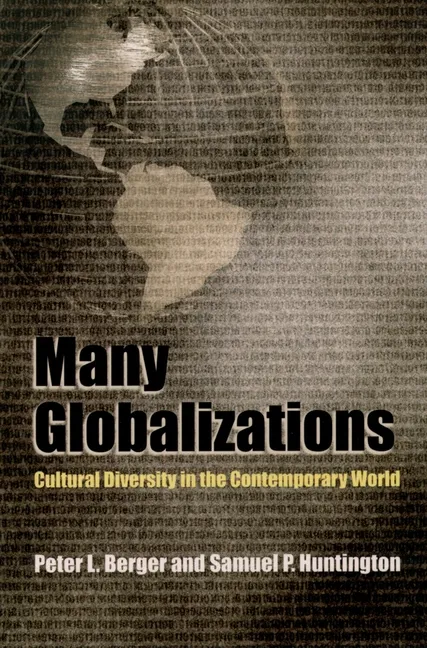
Much discussed but poorly understood, globalization is at once praised as the answer to all the world's problems and blamed for everything from pollution to poverty. Here Berger and Huntington bring together an array of experts who paint a subtle and richly shaded portrait, showing both the power and the unexpected consequences of this great force.
The stereotypes of globalization--characterized as American imperialism on the one hand, and as an economic panacea on the other--fall apart under close scrutiny. Surveying globalization from individual countries of the five major continents, Many Globalizations shows that an emerging global culture does indeed exist. While globalization is American in origin and content, the authors point out that it is far from a centrally directed force like classic imperialism. They examine the currents that carry this culture, from a worldwide class of young professionals to non-governmental organizations, and define globalization's many variations as well as sub-globalizations that bind regions together.
Analytical, incisive and stimulating, Many Globalizations offers rare insight into perhaps the central issue of modern times, one that is changing the West as much as the developing world.
"Provocative.... Taken together, the trenchant, well-written essays included in this collection provide indisputable evidence that an identifiable global culture is indeed emerging."--World Policy Journal
"Analytical and penetrating, belongs...on the desks of anyone with an abiding interest in the forces shaping the world."--Publishers Weekly
Peter L Berger
Peter L. Berger is an internationally renowned sociologist and faculty member at Boston University, where in 1985 he founded its Institute on Culture, Religion, and World Affairs. He is the author of The Social Construction of Reality, The Homeless Mind, and Questions of Faith.
Samuel P Huntington
Samuel P. Huntington was the Albert J. Weatherhead III University Professor at Harvard University, where he was also the director of the John M. Olin Institute for Stategic Studies and the chairman of the Harvard Academy for International and Area Studies. He was the director of security planning for the National Security Council in the Carter administration, the founder and coeditor of Foreign Policy, and the president of the American Political Science Association.













Why Readwise Books?
Readwise Books is an ebook & audiobook platform that automatically logs how much you and your friends read, making it fun and easy to read more. Learn more →